
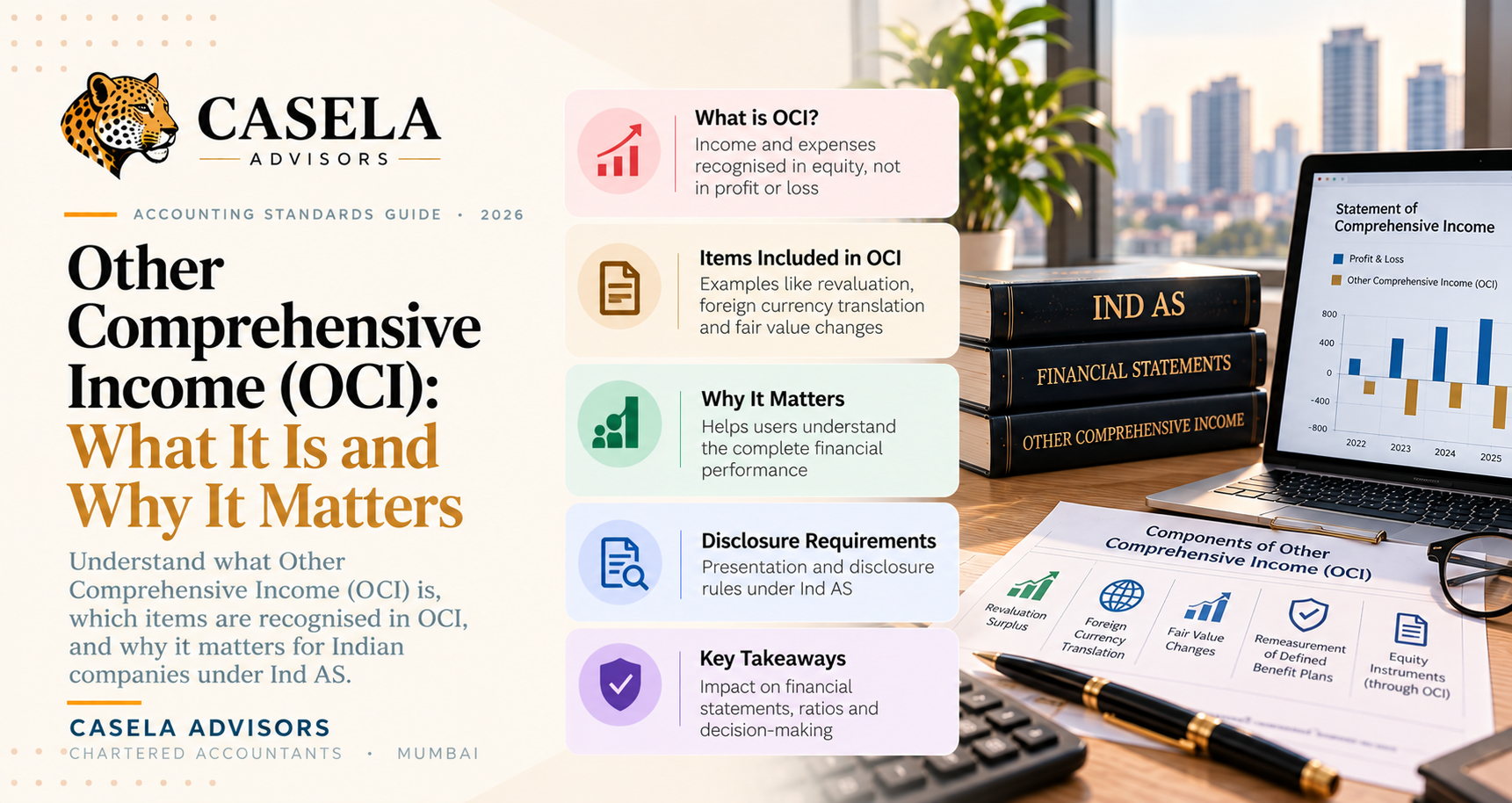
Two companies can report the same profit and have very different changes in equity. The difference is usually other comprehensive income, the part of income and expense that Ind AS keeps outside profit or loss. It is easy to overlook and hard to explain to someone seeing it for the first time.
Casela Advisors is a Chartered Accountant firm in Andheri East, Mumbai. This guide explains what OCI is, which items sit in it, how reclassification works, and what to do to get it right.
What this guide covers — at a glance
- OCI is income that bypasses profit or loss. It captures certain gains and losses that Ind AS says should be recognised in equity first, so that profit is not distorted by them.
- Total comprehensive income = profit + OCI. Together they show the full change in equity from non-owner sources during the period.
- Two buckets. Items that will never be reclassified to profit or loss, and items that may be reclassified when a condition is met.
- Common items include revaluation surplus, actuarial gains and losses, fair value changes on certain investments, cash flow hedge reserves and foreign currency translation differences.
- OCI affects net worth and ratios. Even though it is outside profit, it moves equity, and so it matters to lenders, investors and covenants.
- It applies to Ind AS entities. Companies following Accounting Standards (AS) for smaller entities do not present OCI in the same way.
01What OCI Is
Profit or loss reports the result of operations in a period. Some gains and losses are real but would make that result swing for reasons unrelated to performance, such as a movement in the value of a long-term investment, or an actuarial change in a pension liability. Ind AS therefore requires specified items to be recognised in other comprehensive income instead.
Ind AS 1 defines total comprehensive income as the change in equity during a period from transactions other than those with owners. In practice that is profit or loss plus OCI.
02What Goes Into OCI
Each standard says for itself when an item belongs in OCI. The table collects the common ones and shows whether they can later move to profit or loss.
| Item | Standard | Reclassification |
|---|---|---|
| Revaluation surplus on property, plant and equipment or intangibles | Ind AS 16, Ind AS 38 | Not reclassified |
| Remeasurements of defined benefit plans (actuarial gains and losses) | Ind AS 19 | Not reclassified |
| Fair value changes on equity instruments designated at FVTOCI | Ind AS 109 | Not reclassified to profit or loss |
| Changes in own credit risk on liabilities designated at FVTPL | Ind AS 109 | Not reclassified |
| Foreign currency translation differences on foreign operations | Ind AS 21 | Reclassified on disposal |
| Fair value changes on debt instruments at FVTOCI | Ind AS 109 | Reclassified on derecognition |
| Effective portion of cash flow hedges | Ind AS 109 | Reclassified when the hedged item affects profit or loss |
| Share of OCI of associates and joint ventures | Ind AS 28 | Depends on the nature of the underlying item |
Ind AS 1 requires OCI to be grouped into items that will not be reclassified to profit or loss and items that may be reclassified. Reclassification, also called recycling, moves an amount previously in OCI into profit or loss when a condition is met, such as disposing of a foreign operation.
03A Simple Illustration
The figures are hypothetical, in rupees crore, and shown only to explain the arithmetic.
| Line | Nature | Amount |
|---|---|---|
| Profit for the year | From the statement of profit and loss | ₹100 |
| Actuarial loss on gratuity (net of tax) | Not reclassified | (₹10) |
| Fair value gain on FVTOCI equity investment | Not reclassified to profit or loss | ₹25 |
| Foreign currency translation gain | Reclassifiable on disposal | ₹5 |
| Total comprehensive income | Profit plus OCI | ₹120 |
04How OCI Is Presented
OCI is presented in the statement of profit and loss, after profit, with a total for each of the two groups and the related tax effect. The cumulative balances sit in separate components of equity, such as revaluation reserve or translation reserve, and the movement appears in the statement of changes in equity.
Where an amount is reclassified in the period, the reclassification adjustment is disclosed so that readers can see how much of the period's profit came from past OCI.
05Why It Matters
- Net worth and ratios. OCI changes equity, so it moves net worth, debt-to-equity and other ratios that lenders watch.
- Investor view. Total comprehensive income shows gains and losses that profit alone hides, such as pension remeasurements or investment valuation changes.
- Distributable reserves. Many OCI reserves are not freely distributable, which affects dividend capacity.
- Audit and disclosure. Misclassifying an item between profit and OCI is a presentation error with consequences for earnings and covenants.
06Preparing OCI: A Seven-Step Process
- 1Identify the items. List every balance and transaction where a standard requires OCI treatment: revaluations, post-employment plans, FVOCI investments, hedges and foreign operations.
- 2Classify each one. Decide whether it will or will not be reclassified to profit or loss, because the statement presents them separately.
- 3Measure and tax-effect. Record each item at the amount the standard requires and show the related income tax, or present items before tax with one tax line.
- 4Take it to the right reserve. Accumulate each item in its own component of equity, such as revaluation reserve, FVOCI reserve, cash flow hedge reserve or translation reserve.
- 5Reclassify when required. Where the standard demands recycling, move the amount to profit or loss and disclose the reclassification adjustment.
- 6Present and disclose. Show OCI after profit, group the items by whether they will be reclassified, and disclose tax and reclassification adjustments.
- 7Reconcile equity. Reconcile opening to closing balance of each reserve so the statement of changes in equity agrees.
07Six Common Mistakes
Putting OCI items through profit or loss.
Actuarial gains and losses, FVOCI equity movements and similar items belong in OCI. Routing them through profit distorts earnings and breaches the standard.
Recycling FVOCI equity gains to profit.
Fair value gains on equity instruments designated at FVTOCI are not reclassified to profit or loss on sale. The cumulative amount may only be moved within equity.
Ignoring tax on OCI items.
Deferred tax usually follows the item. If the item is in OCI, so is its tax effect, and the amount must be disclosed.
Missing the reclassification disclosure.
Where amounts are recycled, such as cash flow hedges and debt FVOCI, the reclassification adjustment must be disclosed, not just the net movement.
Forgetting associates' OCI.
The investor's share of an associate's or joint venture's OCI is itself an OCI item and needs to be presented.
Treating OCI reserves as distributable.
Reserves such as revaluation reserve generally cannot be paid out as dividends. Check the legal and standard-specific position before treating them as free reserves.
Working through OCI with us
OCI is where accounting judgement, valuation and presentation meet. We work alongside your finance team from first classification to final disclosure.
Ind AS reporting, OCI workings and reserve reconciliations sit within our virtual CFO and accounting tax compliance practice.
Clean ledgers feed correct OCI balances; see outsourced bookkeeping.
Management reporting that tracks comprehensive income lives in MIS and budgeting.
Foreign operations also raise translation questions; see our guide to Ind AS 21.
Unsure whether an item belongs in OCI? Start through the contact page.
08Frequently Asked Questions on OCI
What is other comprehensive income in simple terms?
It is the part of a company's income and expense that Ind AS requires to be recorded directly in equity rather than in profit or loss, such as revaluation gains or actuarial gains and losses. Added to profit, it gives total comprehensive income.
What is the difference between profit and total comprehensive income?
Profit is the result in the statement of profit and loss. Total comprehensive income is profit plus OCI, so it captures every change in equity apart from transactions with owners.
Is OCI ever reclassified to profit or loss?
Some of it is. Foreign currency translation differences, debt instruments at FVTOCI and the effective portion of cash flow hedges are reclassified when specified conditions are met. Revaluation surplus, actuarial gains and losses and FVOCI equity gains are not.
Where does OCI appear in the financial statements?
In the statement of profit and loss after profit, with items grouped by whether they will be reclassified. Accumulated balances appear as separate components of equity and in the statement of changes in equity.
Do small companies report OCI?
Only entities that apply Ind AS do. Companies following the Accounting Standards for smaller entities generally do not present OCI in this way. Check which framework applies to you.
09The Bottom Line
OCI is not a side note. It is how Ind AS keeps profit meaningful while still telling the whole story of equity. Know which standard sends each item to OCI, whether it recycles, what tax follows it and which reserve holds it, and the statements will reconcile themselves.
Need Help with OCI and Ind AS Reporting?
OCI Classification • Ind AS Financial Statements • Reserve Reconciliations • Virtual CFO Support
+91 9819 000 227 · +91 9819 000 511 · +91 9765 000 966 · info@caselaadvisors.com Head Office — Suit No. 102, L1, Ashok Premises, Nicholas Road, Andheri East, Mumbai — 400069 · Monday to Saturday, 10:00 AM – 7:00 PM