
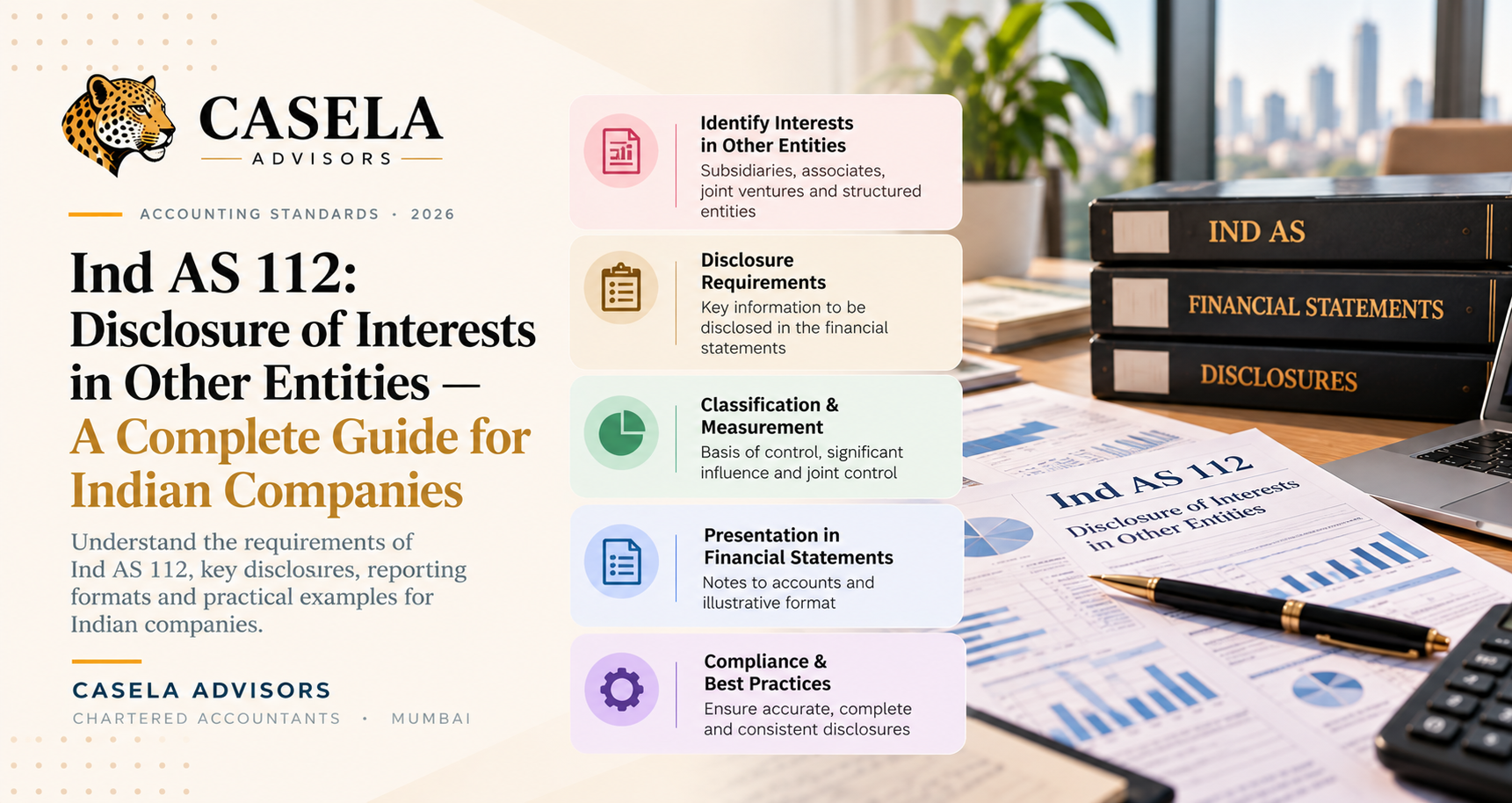
Ind AS 112, "Disclosure of Interests in Other Entities," is one of the most comprehensive disclosure standards issued by the Ministry of Corporate Affairs (MCA) as part of India's convergence with International Financial Reporting Standards. It requires entities to disclose detailed information about the nature of, and risks associated with, their interests in subsidiaries, associates, joint arrangements, and structured entities. For any Indian company operating through a complex group structure, Ind AS 112 is not merely a compliance requirement — it is the backbone of transparent financial reporting.
Casela Advisors is a Chartered Accountant firm based in Andheri East, Mumbai, working with growing businesses and corporate groups on financial reporting, Ind AS compliance, and the accounting infrastructure that sits behind clean consolidated statements. Whether you are a listed company preparing consolidated financial statements or an NBFC assessing structured entity exposure, this guide covers everything you need to know about Ind AS 112 in India — and the note that has to come out the other end. It sits alongside our broader accounting and tax compliance practice, which supports Ind AS reporting for companies under the Companies Act, 2013.
What this guide covers — at a glance
- Ind AS 112 is a disclosure standard, not an accounting one. How you account for subsidiaries, joint arrangements, and associates is governed by Ind AS 110, Ind AS 111, and Ind AS 28 — Ind AS 112 decides what you must reveal about them.
- It reaches most large groups. Listed companies, unlisted companies above the net-worth thresholds, and banks, NBFCs, and insurers on their regulators' timelines all fall within the Ind AS framework — and with it, Ind AS 112.
- The requirements come in four pillars: significant judgements and assumptions, interests in subsidiaries, interests in associates and joint ventures, and interests in unconsolidated structured entities.
- Judgement calls must be shown, not just made. Control with less than half the voting rights, or no significant influence despite more than 20% — the reasoning behind those conclusions is itself a required disclosure.
- Unconsolidated does not mean undisclosed. Securitisation trusts, pass-through structures, and SPVs outside the consolidation perimeter still require disclosure of the nature of involvement and the maximum exposure to loss.
- Weak disclosures carry real consequences. Non-compliance is a financial statement deficiency under the Companies Act, 2013, reportable by the statutory auditor, and actionable by SEBI for listed entities under LODR.
01What Is Ind AS 112 and Why Does It Matter?
Ind AS 112 is India's standard governing disclosures about interests in other entities. It applies when a reporting entity holds interests in subsidiaries, associates, joint ventures, or unconsolidated structured entities. The standard does not dictate how to account for these interests — that is handled by Ind AS 110 (Consolidated Financial Statements), Ind AS 111 (Joint Arrangements), and Ind AS 28 (Investments in Associates and Joint Ventures). Instead, Ind AS 112 specifies what information must be disclosed about those interests so that users of financial statements can evaluate the nature of the interests, the risks involved, and the effects on the reporting entity's financial position and performance.
The standard was notified under the Companies (Indian Accounting Standards) Rules, 2015 and became mandatory in phases — from FY 2016–17 for the first wave of large companies and FY 2017–18 for the second. Its counterparts in the old GAAP framework — AS 21, AS 23, and AS 27 — required far fewer disclosures. Ind AS 112 dramatically raises the bar, requiring entities to disclose not just the list of subsidiaries but the risks, restrictions, and significant judgements used in determining control or significant influence.
Ind AS 112 is India's equivalent of IFRS 12 — "Disclosure of Interests in Other Entities" — issued by the IASB. The two standards are substantially converged, with limited carve-outs for the Indian context.
02Who Is Required to Comply with Ind AS 112?
Listed Companies and Their Subsidiaries
All companies whose equity or debt securities are listed, or are in the process of being listed, on any stock exchange in India are required to prepare financial statements in accordance with Ind AS — which includes Ind AS 112. Any listed company that holds interests in subsidiaries, associates, or joint ventures must therefore prepare detailed Ind AS 112 disclosures in its consolidated financial statements. Our accounting and tax compliance team supports companies in getting these disclosures complete, accurate, and audit-ready.
Unlisted Companies Above the Net-Worth Thresholds
Under the phased rollout of the Companies (Indian Accounting Standards) Rules, 2015, Ind AS became mandatory from 1 April 2016 for companies with a net worth of ₹500 crore or more, and from 1 April 2017 for all listed (and to-be-listed) companies and unlisted companies with a net worth of ₹250 crore or more — with net worth tested against audited financial statements from 31 March 2014 onwards. Once a company falls within the Ind AS framework, it continues to apply Ind AS even if its net worth later falls below the threshold. Holding companies, subsidiaries, joint ventures, and associates of covered companies are also brought in.
Banks, NBFCs, and Insurance Companies
Banks and NBFCs regulated by the Reserve Bank of India, and insurance companies regulated by IRDAI, come under Ind AS with separate transition timelines prescribed by their respective regulators. For NBFCs and banks that hold interests in structured entities — a common feature of securitisation and off-balance-sheet financing structures — Ind AS 112 disclosures on unconsolidated structured entities are particularly important and require careful assessment of the nature and extent of involvement.
Holding Companies with Complex Group Structures
Indian holding companies that control multiple subsidiaries — whether wholly owned or partly owned — across different geographies or sectors must provide a complete picture of their group structure under Ind AS 112. This includes disclosures about non-controlling interests, restrictions on access to assets of subsidiaries, and the financial effects of changes in ownership interests.
03How Did Disclosure Requirements for Group Interests Evolve in India?
Before India's adoption of Ind AS, financial reporting for group entities was governed by the old Indian GAAP standards — AS 21 (Consolidated Financial Statements), AS 23 (Accounting for Investments in Associates), and AS 27 (Financial Reporting of Interests in Joint Ventures). These standards required consolidation and equity accounting, but the disclosure requirements were minimal by modern standards. A holding company could prepare consolidated accounts listing its subsidiaries and associates with limited information about risks or judgements.
The pre-liberalisation era saw very few Indian companies with complex group structures — most large corporates operated as standalone entities or within simple promoter-driven conglomerates. The 1991 economic liberalisation opened India to foreign investment and joint ventures, creating the first wave of complex corporate structures requiring better financial transparency. Yet AS 21, introduced in 2001, only required disclosure of the list of subsidiaries and their key financials — far below international standards of that time.
The push toward Ind AS convergence began earnestly with the Companies Act, 2013, which mandated consolidated financial statements for the first time under primary legislation. The MCA then issued the Companies (Indian Accounting Standards) Rules, 2015 notifying Ind AS — including Ind AS 112 — bringing India substantially in line with IFRS 12. This was a watershed moment: for the first time, Indian companies were required to disclose the significant judgements made in determining control, restrictions on assets of subsidiaries, and the financial impact of structured entities. SEBI, through its Listing Obligations and Disclosure Requirements, reinforced these disclosures for listed entities.
Today, Ind AS 112 is enforced through statutory audit under the Companies Act, 2013 — the disclosure note is among the first things auditors test in a consolidated audit, which is why the preparation and documentation behind it matter as much as the note itself.
04The Four Disclosure Pillars of Ind AS 112
Ind AS 112 organises its disclosure requirements into four broad categories. The table gives the shape; the notes that follow give the substance.
| Pillar | Core disclosures | Most demanding for |
|---|---|---|
| Significant judgements | The judgements and assumptions behind control, significant influence, and joint-arrangement classification | Any group with edge cases — control below 50%, or no influence above 20% |
| Subsidiaries | Group composition, restrictions on assets and fund transfers, changes in ownership, and summarised financials for material NCI | Holding companies with partly owned or regulated subsidiaries |
| Associates & joint ventures | Name, place of business, ownership proportion, nature of relationship, summarised financials, and reconciliation to carrying amount | Equity-method investors with material associates or JVs |
| Unconsolidated structured entities | Nature, purpose, size and activities; related carrying amounts; and maximum exposure to loss | Banks & NBFCs with securitisation and off-balance-sheet structures |
Significant Judgements and Assumptions
The standard requires an entity to disclose the judgements and assumptions it has made in determining the nature of its interest in another entity and in determining the type of joint arrangement in which it has an interest. Key examples include: a case where the entity concludes it has control despite holding less than a majority of voting rights; a case where the entity concludes it does not have significant influence despite holding more than 20% of voting rights; and the determination of whether a structured entity is consolidated.
Interests in Subsidiaries
For interests in subsidiaries, the required disclosures include: the composition of the group (a list of all subsidiaries, including country of incorporation or residence and proportion of ownership interest); the nature and extent of significant restrictions on the ability to access or use assets and settle liabilities of subsidiaries; the nature of the risks associated with interests in consolidated structured entities; the consequences of changes in the ownership interest of a subsidiary; and summarised financial information for each subsidiary with material non-controlling interests.
Interests in Associates and Joint Ventures
For interests in associates and joint ventures accounted for using the equity method, Ind AS 112 requires disclosure of: the name, principal place of business, and proportion of ownership interest for each material associate or joint venture; the nature of the entity's relationship with the associate or joint venture; summarised financial information for material associates and joint ventures; and a reconciliation of that summarised financial information to the carrying amount of the investment.
Interests in Unconsolidated Structured Entities
This is often the most complex part of Ind AS 112. The standard requires disclosure of: the nature, purpose, size, and activities of unconsolidated structured entities with which the entity has involvement; the carrying amounts of assets and liabilities relating to such entities; the maximum exposure to loss from that involvement; and a comparison of the maximum exposure to loss with the carrying amounts of the related assets. For financial entities, this intersects significantly with regulatory reporting to the Reserve Bank of India — see rbi.org.in for RBI guidance on structured entities and off-balance-sheet exposures applicable to NBFCs and banks.
Keeping a structured entity off the balance sheet does not keep it out of the notes. If your business sponsors or is involved with a securitisation trust, pass-through structure, or SPV it does not consolidate, the nature of the involvement and the maximum exposure to loss must still be disclosed — and any financial support provided during the year comes with it.
05How to Prepare Ind AS 112 Disclosures: An Eight-Step Process
Preparing the disclosure note is a structured exercise that needs input from finance, legal, and treasury. This is the sequence we follow with clients:
- 1Map all interests in other entities. Build a complete inventory — wholly and partly owned subsidiaries, associates (20%–50% stake or significant influence), joint ventures, joint operations, and any unconsolidated structured entities such as SPVs, securitisation trusts, or asset management structures. Refresh the map at every reporting date for acquisitions, disposals, and ownership changes.
- 2Assess the nature of each interest. For every entity, determine whether it is a subsidiary (control under Ind AS 110), an associate (significant influence under Ind AS 28), a joint venture or joint operation (Ind AS 111), or a structured entity. These assessments involve significant judgement and must be documented carefully.
- 3Identify significant judgements and assumptions. Ind AS 112 specifically requires disclosure of the judgement calls — control with less than 50% of voting rights, or no significant influence despite more than 20%. Document the reasoning; it will be disclosed.
- 4Gather financial information for each interest. For subsidiaries with material NCI, summarised financial information — assets, liabilities, revenue, profit or loss, cash flows — must be disclosed. For equity-method associates and JVs, disclose the carrying amount and the share of profit or loss and other comprehensive income.
- 5Assess restrictions on assets and liabilities. Disclose significant restrictions on a subsidiary's ability to transfer funds to the parent — regulatory capital requirements, lender covenants, contractual arrangements, or minority shareholders who can block dividends. Banking subsidiaries and entities in exchange-control jurisdictions need particular care.
- 6Assess unconsolidated structured entities. Where the entity sponsors or is involved with a structured entity it does not consolidate, disclose the nature of the involvement, the related carrying amounts of assets and liabilities, and the maximum exposure to loss. Securitisation, pass-through certificates, and off-balance-sheet financing all sit here.
- 7Draft the disclosure note. Cover, in order: the basis for conclusions on significant judgements; interests in subsidiaries including the subsidiary list and NCI information; interests in associates and joint ventures; and interests in unconsolidated structured entities.
- 8Review, audit trail, and sign-off. Have the note reviewed by the statutory auditor and the audit committee, and maintain a documentation trail supporting each disclosure — especially the judgements, structured entity assessments, and restriction disclosures. Our engagements include a documentation review as part of Ind AS reporting support.
06How Ind AS 112 Applies Across Different Industries
Manufacturing and Industrial Groups
Large Indian manufacturing conglomerates — in chemicals, textiles, engineering — typically operate through multiple subsidiaries and joint ventures. For these groups, Ind AS 112 requires a complete group structure chart, disclosure of significant restrictions (such as lender covenants that restrict subsidiary dividends), and summarised financials for subsidiaries with material NCI. The standard also requires disclosure of the financial effects of any acquisition or disposal of subsidiaries during the year.
Financial Services, NBFCs, and Banks
Financial services companies present the most complex Ind AS 112 disclosures. Banks and NBFCs frequently sponsor structured entities — asset-backed securities trusts, pass-through certificates, and co-lending structures — that may or may not meet the consolidation criteria. Where these structured entities are not consolidated, Ind AS 112 requires extensive disclosures about the nature of involvement, the maximum exposure to loss, and any financial support provided during the year — assessments that need to be built and refreshed each reporting cycle, not reconstructed at year-end.
Real Estate and Infrastructure
Real estate developers frequently use joint ventures and special purpose vehicles for project development. Under Ind AS 112, the nature of these arrangements — whether they are joint ventures (accounted for under the equity method) or joint operations (assets and liabilities recognised directly) — must be carefully assessed and disclosed. For developers with multiple project SPVs, the disclosure note can be extensive, covering dozens of entities and significant judgements about the nature of control.
Technology and Startup Ecosystems
Technology companies and startups that have received venture funding often hold minority stakes in other entities or are themselves held by holding companies. For these entities, Ind AS 112 disclosures about the nature of significant influence (where a 20–50% stake exists) and the basis for consolidation decisions become increasingly important as they scale — and a review of Ind AS 112 compliance belongs in any pre-IPO financial due diligence exercise.
Working through Ind AS 112 with us
The disclosure note is the visible end of the work — the entity mapping, judgement documentation, and clean underlying books are what make it defensible in audit. That is where we sit: alongside your finance team, from ledger to note. Our accounting and tax compliance page sets out the range.
For Ind AS reporting and disclosure preparation end to end — gap analysis, judgement documentation, and the note itself — that is our virtual CFO and accounting tax compliance practice.
Group reporting packs, NCI summaries, and entity-level financial information for the note draw on MIS and budgeting discipline maintained through the year.
Summarised financials are only as good as each entity's ledger — outsourced bookkeeping keeps subsidiary and SPV books consolidation-ready.
Where the group also needs its statutory cycle handled, GST and TDS return filing run alongside the reporting work under one engagement.
Not sure whether Ind AS applies to your group at all, or which phase you fall in? Start with a conversation through the contact page.
07Frequently Asked Questions on Ind AS 112
What is the difference between Ind AS 112 and the old AS 21 / AS 23 / AS 27?
AS 21, AS 23, and AS 27 under old Indian GAAP required consolidation and equity accounting but with minimal disclosure requirements. Ind AS 112 dramatically expands the disclosure requirements — requiring companies to disclose significant judgements used to determine control or significant influence, summarised financial information for material subsidiaries with NCI, and detailed disclosures about unconsolidated structured entities. Ind AS 112 is substantially converged with IFRS 12 and represents a significant step up in disclosure quality.
Does Ind AS 112 apply to standalone financial statements?
Ind AS 112 primarily applies to consolidated financial statements. However, an entity that prepares standalone financial statements and is exempt from preparing consolidated financial statements (for example, a wholly owned subsidiary that meets the exemption criteria under Ind AS 110) must still disclose this fact and the name of the parent that publishes consolidated financial statements. In practice, most of the detailed Ind AS 112 disclosures are made in the consolidated financial statements.
What is a structured entity under Ind AS 112 and why does it matter?
A structured entity is one that has been designed so that voting or similar rights are not the dominant factor in deciding who controls the entity — for example, where voting rights relate to administrative tasks only and the relevant activities are directed by means of contractual arrangements. Common examples in India include securitisation trusts, pass-through certificate structures, and co-lending SPVs. Ind AS 112 requires entities to disclose the nature of their involvement with unconsolidated structured entities — including the maximum exposure to loss — even if those entities are not consolidated.
How are non-controlling interests disclosed under Ind AS 112?
For subsidiaries where there are material non-controlling interests, Ind AS 112 requires disclosure of summarised financial information — including assets, liabilities, revenue, profit or loss attributable to NCI, and cash flows. The standard also requires disclosure of any significant restrictions on the ability of the subsidiary to transfer funds to the parent — for example, regulatory minimum capital requirements that effectively restrict dividend payments.
What are the penalties for non-compliance with Ind AS 112 in India?
Non-compliance with Ind AS 112 is treated as a deficiency in the financial statements under the Companies Act, 2013. The statutory auditor is required to report material non-compliance with Ind AS under CARO 2020 and the Companies (Audit and Auditors) Rules. Additionally, SEBI can take action against listed companies for inadequate disclosures under the Listing Obligations and Disclosure Requirements (LODR) Regulations. Qualified audit opinions arising from Ind AS 112 non-compliance can impact a company's reputation and ability to raise capital.
08The Bottom Line
Ind AS 112 asks one question of every group: can a reader of your financial statements understand what you hold, why you concluded you control or influence it, and what you stand to lose? Answering that well starts long before the note is drafted — with a complete entity map, documented judgement calls, entity-level financials that reconcile, and structured entity exposures measured rather than assumed. Build those through the year, and the disclosure note becomes an output of the process instead of a year-end scramble the audit then takes apart.
Need Expert Help with Ind AS 112 Disclosures?
Ind AS Reporting Support • Group Structure Mapping • Judgement Documentation • NCI & Structured Entity Disclosures • MIS and Budgeting • Virtual CFO Support
+91 9819 000 227 · +91 9819 000 511 · +91 9765 000 966 · info@caselaadvisors.com Head Office — Suit No. 102, L1, Ashok Premises, Nicholas Road, Andheri East, Mumbai — 400069 · Monday to Saturday, 10:00 AM – 7:00 PM