
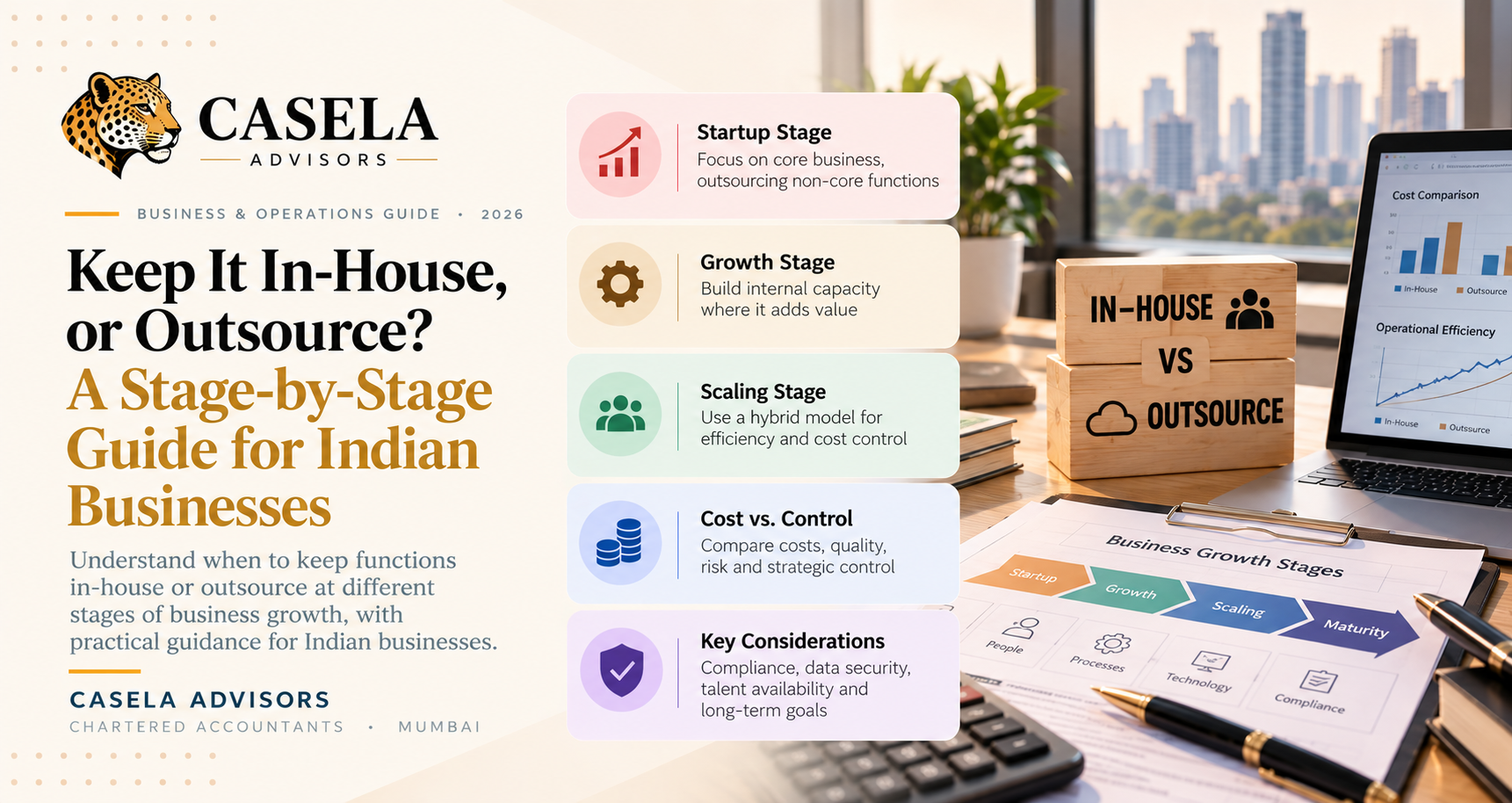
Every growing Indian business reaches the same question: should we keep accounting in-house, or hand it to a specialist firm? Asked in the abstract, there is no right answer. Asked at a specific stage of growth, there usually is one — and it changes more than once.
Casela Advisors is a Chartered Accountant firm in Andheri East, Mumbai, and we work with businesses at almost every one of these stages. This guide sets out what we see: the five stages a finance function tends to pass through, where the cost crossover sits, who stays responsible when work is outsourced, and how to switch without breaking your books.
What this guide covers — at a glance
- The right answer changes with size. A founder-run business, a ₹3 crore company and a ₹30 crore group need very different finance set-ups. Pick the model for the stage you are in, not the one you hope to reach.
- Most growing businesses end up hybrid. Day-to-day bookkeeping and compliance filings are outsourced; judgement, approvals and cash decisions stay in-house.
- Volume is the cleanest test. As a rough rule, somewhere around 550–600 transactions a month, the cost and management load of a full in-house accounting team starts to compete with a specialist firm.
- Outsourcing the work does not outsource the responsibility. Directors remain answerable for books, filings and, increasingly, for how personal data is handled by providers.
- Switching is a project, not a handover. Cut-off dates, access, opening balances and documentation decide whether the change is smooth or costly.
- Watch for the warning signs. Late closes, reconciliation backlogs, key-person dependence and surprise tax notices usually mean the current model has been outgrown.
01The Five Stages of a Finance Function
Finance rarely arrives all at once. It grows in steps, and each step changes who should be doing what. The turnover bands below are indicative — complexity, industry and number of entities matter as much as revenue.
| Stage | Annual turnover (indicative) | Typical set-up | Leaning |
|---|---|---|---|
| Stage 1 — Founder-run | Below ₹20 lakh | Founder or a family member keeps books on accounting software; a CA files GST, TDS and the annual return. | Mostly in-house |
| Stage 2 — First outside help | ₹20 lakh to ₹1 crore | Monthly bookkeeping and compliance move to a part-time accountant or outsourced firm; the founder still approves payments. | Outsource the routine |
| Stage 3 — The hybrid | ₹1 crore to ₹5 crore | An in-house finance executive handles invoicing, collections and payables; the firm handles books, reconciliations, returns and review. | Hybrid |
| Stage 4 — Internal core | ₹5 crore upward | A finance manager or controller owns the close and MIS; specialists are retained for tax, audit support and advisory. | Hybrid, leaning in-house |
| Stage 5 — Finance department | Beyond ₹25 crore | A structured team under a CFO runs accounting, treasury, reporting and controls; outsourcing is selective (compliance peaks, projects, specialist tax). | Mostly in-house, selective outsourcing |
Treat the bands as signposts, not rules. A ₹3 crore trading business with thousands of small invoices can need more help than a ₹10 crore consultancy with a handful of large ones.
02Where the Crossover Sits
The most useful single measure is transaction volume — invoices, bills, receipts, payments, journals and payroll entries combined. At low volumes, a specialist firm's shared team and software are almost always cheaper than a salaried accountant who is only partly utilised. At high volumes, the maths shifts and a dedicated internal team can win on cost and responsiveness.
In our experience that crossover tends to fall somewhere around 550–600 transactions a month. Below it, outsourcing usually costs less for the same quality. Above it, a full in-house team becomes comparable or cheaper — provided you can hire, supervise and cover absence.
Before you apply the number
- It is a rule of thumb. Multi-state GST registrations, inventory, foreign currency and multiple entities raise the effective workload per transaction.
- Count the full cost. Salary, provident fund and benefits, software licences, training, supervision and the cost of cover when someone is away.
- Count the cost of errors. A single missed input credit or late return can outweigh a year of fee savings.
- Quality is not volume. A big in-house team with no review is worse than a small one with proper controls.
03Outsourcing the Work Does Not Outsource the Responsibility
Whichever model you choose, the company and its directors remain responsible for maintaining proper books, filing returns on time and signing the financial statements. A provider can do the work; it cannot take the accountability. This is why access, approvals and review stay with you.
Accounting and payroll work involves personal data — employees, customers, vendors. India's Digital Personal Data Protection Rules were notified on 13 November 2025 with a phased rollout, and the main obligations are due to apply in full on 13 May 2027. A business that decides how personal data is used generally stays responsible for it even when a provider handles it for them.
Use this year to check provider contracts for confidentiality, security measures, breach notification, sub-contractors and deletion on exit. Take legal advice on your own position.
04Comparing the Risks
Neither model is risk-free. The risks are different, and the controls that address them are different too.
| Risk | In-house | Outsourced |
|---|---|---|
| Key-person dependence | High — one accountant leaving can stall the function | Lower — a team covers absence, but you depend on the firm |
| Capacity at peak times | Fixed; year-end and audit squeeze a small team | Flexible, subject to the agreed scope |
| Specialist knowledge | Limited to what you can hire and train | Broader, shared across clients |
| Control and responsiveness | High — the team sits with you | Depends on service levels and communication |
| Data and confidentiality | Contained in your systems | Needs contract terms and access controls |
| Continuity of records | Held by you, but often undocumented | Needs a clean handover if you ever switch |
05Switching Without Breaking Your Books
Moving from in-house to outsourced, or the other way, is where most of the avoidable cost arises. These seven steps keep the change controlled:
- 1Agree the cut-off date. Pick a clean month-end or quarter-end so the old and new providers each own a defined period, and note what is still pending on that date.
- 2Take stock of access. List every login that matters — accounting software, GST and TDS portals, bank access, payroll — and who holds it. Change shared passwords and remove departed users.
- 3Hand over the opening position. Closing trial balance, bank and loan statements, fixed asset register, debtor and creditor ageing, and the last filed returns.
- 4Reconcile before you hand over. Bank, GST (books against GSTR-2B), TDS (books against Form 26AS / AIS) and intercompany balances should tie out, or the differences should be listed.
- 5Document how things are done. Chart of accounts, approval limits, expense policies, recurring journals and filing calendar. If it lives only in someone's head, write it down now.
- 6Run both in parallel for one cycle. One month with the outgoing and incoming teams side by side catches most mapping and cut-off errors before they reach a return.
- 7Review and sign off. Compare the first closed month with the prior pattern, confirm filings are on the calendar, and record who is accountable for each deliverable.
06Six Warning Signs You Have Outgrown Your Model
You do not need a consultant to tell you when the current set-up has stopped working. These are the signals we see most often.
The month-end close keeps slipping.
If books are regularly finished weeks after the month ends, decisions are being made on old numbers. This is usually a capacity or process problem, not a motivation one.
Reconciliations are always "nearly done".
Bank, GST and TDS differences that carry forward month after month turn into notices, lost input credit and awkward audit queries.
One person holds all the knowledge.
If the whole function stops when a single accountant or the founder is unavailable, you have a key-person risk — in-house or outsourced.
You hear about tax problems from the department first.
Late fees, interest, mismatched credits and notices that arrive before your own team has spotted the issue point to weak review.
The founder is still the finance function.
When the person who should be selling or building spends evenings on vouchers and filings, the real cost is not the salary saved.
Cost is rising but visibility is not.
More staff, more software and more tools, yet no reliable MIS or cash forecast. You are paying for activity rather than information.
Working through this with us
Whether you are outsourcing for the first time, building a hybrid, or bringing work back in, we can sit alongside your team. These are the services that most often come into play:
For the monthly engine — voucher entry, reconciliations and closing — see outsourced bookkeeping.
For a finance lead without a full-time hire — review, controls, cash planning and board-ready numbers — that is our virtual CFO and accounting tax compliance practice.
Management reporting and budgets that the founder actually reads are covered under MIS and budgeting.
Statutory filings that should never depend on one person's memory: GST return filing and TDS return filing.
Not sure which stage you are at, or what a hybrid would look like for you? Start with a conversation through the contact page.
07Frequently Asked Questions
At what size should a small business stop doing its own accounting?
There is no single line, but the usual trigger is when the founder's time or the error rate becomes the constraint — often when turnover moves past the low tens of lakhs, or when GST and TDS filings start to compete with selling. At that point, outsourcing the routine work is typically cheaper than the cost of mistakes and lost time.
Is outsourcing accounting cheaper than hiring an accountant?
Often at lower volumes, because you pay for a team's capacity and software rather than one salary, leave cover and training. As volumes and complexity grow, an internal team can become more economical. Compare the full cost of each — salary, benefits, software, supervision and the cost of absence — rather than the headline fee.
What does a hybrid model look like in practice?
An internal person handles invoicing, collections, payments and day-to-day queries. An outside firm keeps the books, runs reconciliations, files returns and reviews the close. The founder or finance lead approves payments and reads the monthly MIS.
Does using an outsourced provider create data-protection obligations for us?
Yes. If a provider processes personal data on your behalf — employee, customer or vendor data — the business that decides why and how it is processed generally remains responsible for it. Under India's Digital Personal Data Protection framework, the main obligations are due to apply in full on 13 May 2027, so provider contracts should address security, confidentiality, breach notification and deletion. Take legal advice on your specific position.
How long does it take to switch from one accounting provider to another?
For a small or mid-sized business a clean switch usually takes one to two closing cycles, including a parallel run. Complex groups, backlogs or poor documentation take longer. Starting just after a quarter-end or year-end makes the cut-off simpler.
08The Bottom Line
Treat the in-house-or-outsource question as a stage decision, not a one-time choice. Outsource the routine early, build an internal core as volume and complexity grow, and keep judgement, approvals and cash decisions close to the business throughout. Whatever you choose, keep access, documentation and review in your hands — that is what makes any model switchable.
Not Sure Which Stage You Are At?
Outsourced Bookkeeping • Virtual CFO Support • MIS and Budgeting • GST & TDS Compliance • Finance Function Review
+91 9819 000 227 · +91 9819 000 511 · +91 9765 000 966 · info@caselaadvisors.com Head Office — Suit No. 102, L1, Ashok Premises, Nicholas Road, Andheri East, Mumbai — 400069 · Monday to Saturday, 10:00 AM – 7:00 PM