
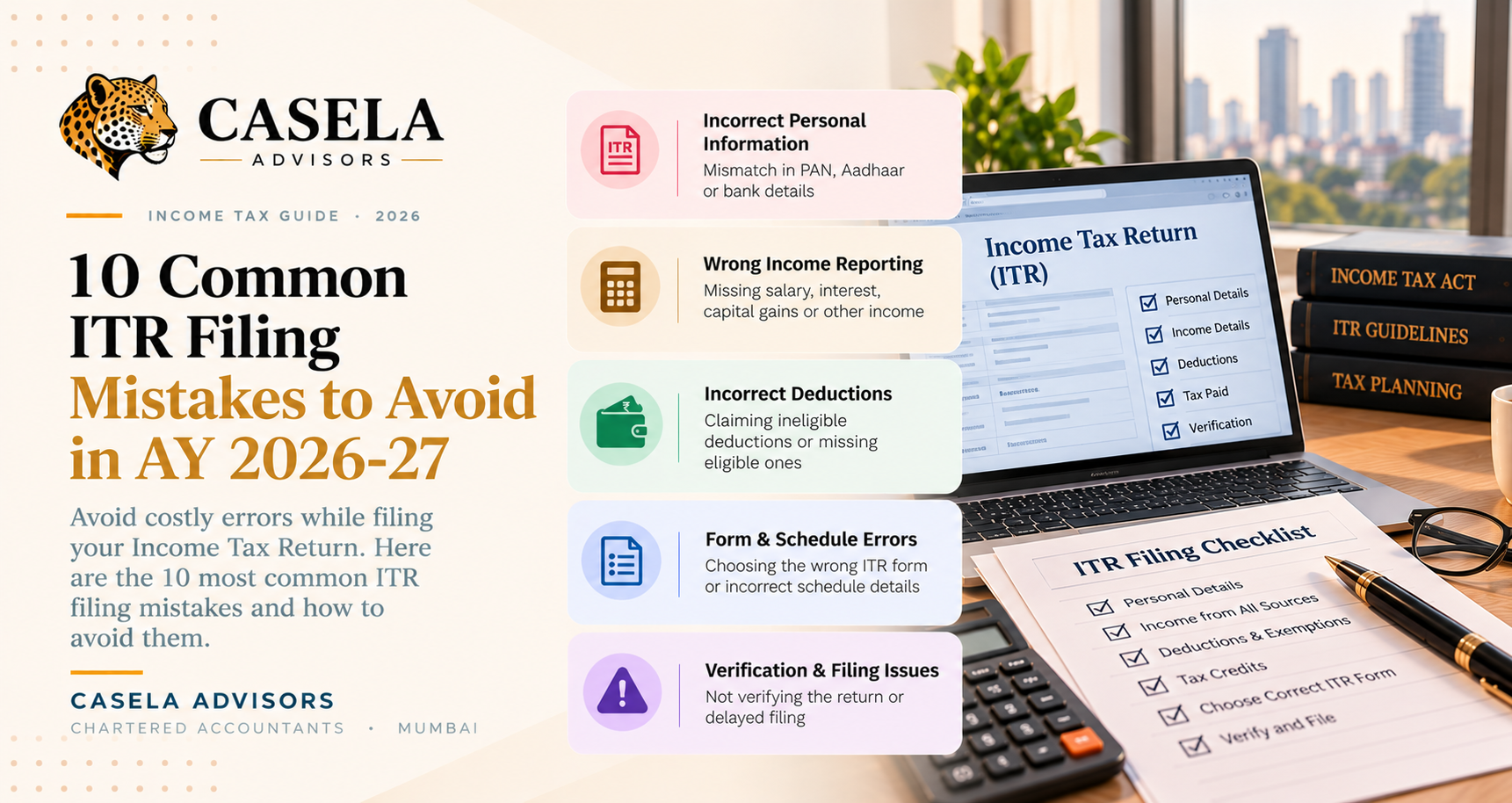
Each year, Casela Advisors processes hundreds of ITR filings for AY 2026-27 across salaried individuals, business owners, NRIs, and companies across India. And each year, the same set of mistakes appears: wrong forms filed, income not declared because it was not visible in salary statements, e-verifications forgotten, and regime selections made by default rather than by calculation.
With the July 31, 2026 deadline and the Income Tax Department’s AIS now capturing income from more sources than ever before, the cost of these ITR filing mistakes has never been higher. Each error can generate an automated notice under Section 143(1), requiring responses and potentially additional tax, interest, and penalties. Some mistakes — like missing the deadline or failing to e-verify — cannot be corrected retroactively.
| # | Mistake | Consequence |
|---|---|---|
| 1 | Filing wrong ITR form | Defective return notice Section 139(9) — must refile |
| 2 | Not reconciling AIS first | Section 143(1) mismatch notice with tax demand |
| 3 | Wrong Section 87A claim | Incorrect return, demand notice, potential penalty |
| 4 | Unreported income sources | Section 143(1) adjustment or scrutiny notice |
| 5 | Wrong tax regime selected | Pays excess tax; refund requires revised return |
| 6 | Skipping e-verification | Return treated as never filed; deadline missed |
| 7 | Capital gains not reported | High-probability scrutiny; 143(1) notice; penalty |
| 8 | Deductions claimed without proof | AIS mismatch or future scrutiny; demand notice |
| 9 | Self-assessment tax not paid before filing | Defective/invalid return; interest Section 234B |
| 10 | Missing July 31, 2026 deadline | Permanent loss of carry-forward rights |
What this guide covers — at a glance
- The AIS mismatch is the single biggest notice trigger — download and review your AIS before opening the ITR form.
- Section 87A has three specific error patterns — NRIs, special-rate capital gains, and old-regime income above Rs. 5 lakh are all common incorrect claims.
- E-verification within 30 days is mandatory — filing without e-verifying means the return never existed, legally.
- Capital loss carry-forward is permanently lost if the return is not filed by July 31 — this cannot be recovered by filing a belated return.
- File by July 25 to avoid portal congestion — the Income Tax portal experiences heavy server load July 29–31.
Filing the Wrong ITR Form
With seven ITR forms (ITR-1 through ITR-7), selecting the wrong one is more common than it should be. The most frequent error is salaried employees filing ITR-1 (Sahaj) when they should be filing ITR-2 — because of mutual fund redemptions, share sales, or a second house property.
- Salary + mutual fund redemption → ITR-1 filed → Wrong. Mutual fund gains require ITR-2.
- Salary + two house properties → ITR-1 filed → Wrong. More than one house property requires ITR-2.
- Freelance income + salary → ITR-1 filed → Wrong. Business/professional income requires ITR-3.
- NRI with Indian income → ITR-1 filed → Wrong. NRIs must use ITR-2; ITR-1 is only for residents.
A defective return notice under Section 139(9) is issued when the wrong form is used. The department gives you 15 days to correct it — missing this window makes it non-filed.
Before filing, check all your income sources in AIS. If there is ANY capital gain, foreign asset, more than one property, or business income — use ITR-2 or ITR-3 as applicable. When in doubt, use the more comprehensive form.
Not Reconciling AIS Before Filing
The Annual Information Statement (AIS) captures your income from over 30 data sources — banks, stock exchanges, mutual fund registrars, property registrars, employers, and more. When you file, the department’s system compares your declared income with AIS data in real time. Any discrepancy triggers an automated Section 143(1) intimation with a tax demand.
What AIS captures that people commonly miss:
- Savings account interest and FD interest — reported by every bank automatically
- Dividend income — reported by registrar even for amounts as small as Rs. 10
- Mutual fund redemption proceeds — reported by AMFI/CAMS/KFintech
- Share sale proceeds — reported by stock exchanges (BSE/NSE)
- Property purchase and sale — reported by sub-registrar offices
- Rent payments received from tenants who deducted TDS
- Foreign remittances — reported under FATCA by banks
Download your AIS from the income tax portal (Services → AIS) before opening the ITR. Review every entry. Flag and dispute incorrect entries directly in AIS. Only file after verifying that your ITR income matches or explains every AIS entry.
Claiming Section 87A Rebate Incorrectly
The Section 87A rebate for AY 2026-27 produces zero tax on income up to Rs. 12 lakh under the new regime — but three specific groups claim it incorrectly, creating notices and demands.
Error 3A: NRIs claiming Section 87A
Section 87A is available only to Resident Individuals. NRIs who file for Indian-source income and apply the rebate are filing incorrectly. The department’s system cross-references residential status and automatically identifies this error, generating a demand notice.
Error 3B: Applying Section 87A to special-rate capital gains
The rebate does not apply to income taxed at special flat rates — STCG at 20% (Section 111A), LTCG at 12.5% (Section 112A), or online gaming winnings at 30%. A taxpayer with Rs. 6 lakh salary and Rs. 4 lakh STCG from mutual funds who applies Section 87A to wipe out the STCG tax will have this claim disallowed on processing.
Error 3C: Claiming Section 87A under old regime above Rs. 5 lakh
Under the old tax regime, Section 87A is available only when total income does not exceed Rs. 5 lakh — the rebate is Rs. 12,500. Taxpayers on old regime with Rs. 8 lakh income cannot claim the Rs. 60,000 rebate. Only under the new regime is the Rs. 12 lakh threshold applicable.
If you are a Resident Individual with total income ≤ Rs. 12 lakh under new regime (excluding special-rate income), you qualify. For NRIs, those with special-rate capital gains, and old-regime filers above Rs. 5 lakh — Section 87A does not apply. Let the portal compute it automatically; do not manually override.
Not Reporting All Income Sources
This is the most prevalent trigger for Section 143(1) ITR filing notices in AY 2026-27. Every income source that appears in AIS but is not declared in your ITR creates an automatic mismatch notice. The income sources most commonly missed:
- FD and savings interest — every bank reports interest paid to PAN holders. The Section 80TTA deduction (Rs. 10,000 for savings interest) reduces the taxable amount, but the gross interest must still be declared.
- Dividend income — every dividend from shares and mutual funds is reported by registrars. Dividends are taxable at slab rates post-2020 regardless of amount.
- Mutual fund redemptions — even small liquid fund redemptions create capital gains that must be reported. The AIS shows gross redemption proceeds; the ITR must show the gain/loss.
- Income from additional employer — salaried individuals who switched jobs receive Form 130 from each employer. Income from both must be consolidated; AIS picks up TDS from both.
- YouTube, freelance, or gig income — reflected in AIS if GST or TDS was deducted. Non-disclosure can be identified through Form 26AS or AIS bank credits.
- Rental income from informal tenants — even where no TDS was deducted, the department can identify it through bank credits. Standard deduction of 30% applies.
Go through your bank statements for the full FY 2025-26. Any credit that is not from salary, exempted sources (PPF, EPF), or capital returns needs to be evaluated for income tax. Cross-reference every item with your AIS.
Selecting the Wrong Tax Regime
The new tax regime is the default for AY 2026-27. If you filed without explicitly choosing a regime, you have been placed in the new regime. Two types of regime mistakes occur:
- Paying under old regime but not switching to new regime at filing — if your employer deducted TDS under old regime but the new regime produces lower tax (particularly below Rs. 12 lakh where Section 87A makes it zero), you should switch at filing and claim a refund of excess TDS.
- Filing under new regime when old regime is better — if you have large home loan interest (Rs. 2 lakh), full 80C (Rs. 1.5 lakh), NPS (Rs. 50K), and health insurance (Rs. 50K) — total Rs. 4.5 lakh in deductions — old regime may produce less tax above Rs. 15 lakh income. Filing under new regime unnecessarily overpays.
Salaried individuals (with no business income) can switch between regimes every year at the time of filing. This flexibility must be actively exercised — it does not happen automatically.
Compute your tax under both regimes using your actual income and actual deductions before selecting a regime in the ITR. Casela Advisors’ income tax computation service can run this comparison for you.
Forgetting to E-Verify Within 30 Days
This is the most painful ITR mistake because it is entirely avoidable. Filing the ITR online is not the final step. You must e-verify within 30 days of filing. An unverified return is treated as if it was never filed at all.
If you file on July 28, 2026 but e-verify on August 30, 2026 — your filing date becomes August 30. You owe Rs. 5,000 late filing fee under Section 234F, interest under Section 234A on unpaid tax, and the right to carry forward losses is permanently lost.
E-verification options:
Aadhaar OTP
30 seconds, immediate. Use this on the same day as filing.
Net Banking EVC
Via income tax portal through authorised bank.
NSDL/CDSL Demat
Through your demat account EVC generation.
ITR-V by Post
Last resort only — postal delays are uncontrolled.
E-verify using Aadhaar OTP immediately after filing — in the same browser session. Do not close the portal or “do it later.” The entire filing process including e-verification takes 5 minutes; never leave this step incomplete.
Not Reporting Capital Gains
Capital gains from shares, mutual funds, property, and other assets are separately taxable and must be reported in every ITR — even if the net amount is small, even if you made a loss, and even if income is below the basic exemption limit. With all capital gains transactions visible in AIS, this is one of the highest-detection areas for non-compliance.
- Mutual fund SIP redemptions — each SIP unit sold is a separate taxable event. Every redemption must be computed unit-by-unit. Liquid, debt, and equity fund redemptions all generate capital gains.
- Stock trading gains/losses — even small stock transactions show in AIS. Loss transactions must also be reported — they can be carried forward to offset future gains, but only if declared in the ITR.
- Property sale — LTCG from property sold after 2 years are taxable at 12.5% under Section 112. Sub-registrar reports the sale to AIS. Non-disclosure is one of the highest-risk ITR errors for property sellers.
- Inherited property sold — many filers omit this because they consider inherited property exempt. It is not. Capital gains apply, with the original cost (or FMV as on April 1, 2001) determining the gain.
- Crypto and virtual digital assets — VDA gains are taxable at 30% under Section 115BBH. TDS at 1% was deducted on transactions; AIS shows sale proceeds. Non-disclosure is detectable.
Capital gains require ITR-2 (not ITR-1). For companies and LLPs, capital gains are covered in ITR-6 and ITR-5 respectively — all through Casela Advisors’ statutory audit and compliance services.
Download your CDSL/NSDL statement, mutual fund capital gains statement from CAMS/KFintech, and sale deed for any property sold. Compute gains for each transaction. If the computation is complex, Casela Advisors’ income tax computation team can handle this.
Claiming Deductions Without Adequate Documentation
Under the old tax regime, deductions under Section 80C, 80D, and other sections are only valid when actual qualifying investments or expenses were made. Two types of errors occur:
- Overclaiming 80C — declaring EPF, ELSS, PPF, and LIC premium totalling Rs. 1.5 lakh without verifying exact amounts from statements. If the actual qualifying investment is only Rs. 1.2 lakh, the ITR overstates by Rs. 30,000.
- Claiming 80D for lapsed or non-existent health insurance — health insurance premium payments are cross-checked against GST data and insurer reports. Claiming 80D for a policy that was not in force creates scrutiny risk.
- Claiming HRA without paying actual rent — HRA exemption requires actually paying rent to a landlord who is not a spouse. Fabricating rent receipts is tax fraud. For genuine HRA claims above Rs. 1 lakh annually, landlord PAN must be provided.
Before claiming any deduction, confirm the actual amount invested or paid with the relevant statement or receipt. Claim only what is documented. The saved tax from an inflated claim is never worth the risk of scrutiny and penalty under internal audit or assessment.
Filing Without Paying Self-Assessment Tax First
If your total tax liability for AY 2026-27 exceeds the TDS already deducted, you have a balance tax payable. This balance must be paid as self-assessment tax before filing — not after. Filing with unpaid tax due makes the return technically defective and immediately attracts interest under Section 234B.
Compute: Tax on total income minus TDS per Form 168/26AS = balance due. Pay via Challan 280 at the income tax e-filing portal under e-Pay Tax. Select AY 2026-27 and Self-Assessment Tax (Code 300). Enter the challan identification number (CIN) in your ITR under the Self-Assessment Tax schedule before submitting. Interest under Section 234B (1% per month from April 1, 2026) must also be paid and is separate from the self-assessment tax.
Compute your total tax liability before filing. Pay the balance via Challan 280 online. Wait 1–2 banking hours for the challan to reflect in your tax credit — then file the ITR with the challan number entered correctly. Casela Advisors’ income tax computation service computes the exact self-assessment tax before filing.
Missing the July 31, 2026 Deadline
The ITR filing due date for AY 2026-27 is July 31, 2026 for individuals and entities not covered by tax audit. Missing this date triggers a permanent loss of certain tax benefits that cannot be recovered.
| Consequence | Details | Reversible? |
|---|---|---|
| Late filing fee — Section 234F | Rs. 5,000 (Rs. 1,000 if income ≤ Rs. 5 lakh) | No — auto-applied |
| Interest — Section 234A | 1% per month on unpaid tax from July 31 | No — accumulates |
| Capital loss carry-forward forfeited | Losses from shares, MF, property permanently lost | No — permanent |
| Business loss carry-forward forfeited | Business/professional losses cannot be set off | No — permanent |
| No revision after Dec 31 | Belated return cannot be revised after Dec 31, 2026 | No — window closes |
| TDS refund delayed | Portal gives priority to timely returns | Partial |
The Income Tax portal experiences heavy server load in the last 48–72 hours before the deadline — July 29–31. Technical errors, OTP failures, and payment gateway issues have historically left thousands unable to file on time. Filing by July 25, 2026 is strongly recommended.
File and e-verify before July 25, 2026. If you have complex returns (capital gains, business income, foreign income), start the computation immediately. Casela Advisors accepts and processes urgent ITR filings up to July 29.
AY 2026-27 Specific Mistakes With New Income Tax Forms
The Income Tax Act 2025, effective April 1, 2026, introduced new form numbers. Two documentation errors to avoid for AY 2026-27:
- Using old Form 26AS instead of Form 168 — for AY 2026-27, the tax credit statement is now Form 168. Some taxpayers pull Form 26AS for a prior year by mistake and compute TDS credits from incorrect data.
- Salary TDS mismatch from Form 130 vs employer records — Form 130 replaces Form 16. If your employer issued an incorrect Form 130 (wrong salary or wrong TDS), request a corrected Form 130 before filing. Do not go with pre-filled ITR data if it does not match your actual salary records.
11Already Filed With a Mistake? Here’s What to Do
If you have already filed and then identified an error, the options are:
- 1Revised return — Section 139(5): File a revised ITR by December 31, 2026 (or before assessment, whichever is earlier). The revised return completely replaces the original. Multiple revisions are permitted.
- 2Defective return — Section 139(9): If you received a defective return notice (wrong form, missing schedules), respond within the 15-day window given in the notice.
- 3Updated ITR (ITR-U) — Section 139(8A): For past years (not current year during the original filing window), ITR-U allows filing within 48 months of the assessment year end — subject to a 25–70% additional tax on the differential.
How Casela Advisors can help
Complete ITR filing for AY 2026-27 — including AIS reconciliation, regime comparison, capital gains computation, Section 87A eligibility check, self-assessment tax calculation, and same-day e-verification.
Income tax computation — regime comparison, capital gains, self-assessment tax, and Challan 280 preparation
AIS reconciliation — review every AIS entry against your income before filing
ITR true copy certification — for loans, visas, and tenders
Revised return preparation and notice response for defective or incorrect returns
12Frequently Asked Questions
What is the most common ITR filing mistake in AY 2026-27?
The single most common ITR filing mistake in AY 2026-27 is not reconciling the Annual Information Statement (AIS) before filing. The AIS captures income from all sources — FD interest, dividends, mutual fund redemptions, share sales, and property transactions — reported by banks, stock exchanges, and other institutions. If income visible in AIS is not declared in the ITR, the department’s automated system generates a Section 143(1) notice identifying the mismatch and raising a demand for the shortfall. This is fully avoidable by downloading and reviewing the AIS before filing.
What happens if I file the wrong ITR form?
Filing the wrong ITR form results in a defective return notice under Section 139(9) of the Income Tax Act. A defective return is treated as if it was never filed until the defect is corrected. You typically have 15 days from the date of the notice to re-file under the correct form. If you miss the correction window, it may be treated as a non-filing, which attracts late filing fees under Section 234F, interest under Section 234A, and permanent loss of the right to carry forward losses.
What is the consequence of not e-verifying the ITR within 30 days?
An ITR that is filed but not e-verified within 30 days of filing is treated as if it was never filed at all. The filing date for all penalty and interest purposes reverts to the date of e-verification, not the date of online submission. If you file on July 28 and e-verify on August 15, your filing date is treated as August 15 — after the July 31 deadline — and late filing fees under Section 234F apply. E-verification using Aadhaar OTP should be completed on the same day as filing, in the same browser session.
Can I correct ITR mistakes after filing?
Yes. If you filed your original ITR on or before July 31, 2026, you can file a revised return under Section 139(5) at any time before December 31, 2026 (or before assessment, whichever is earlier). A revised return completely replaces the original — multiple revisions are permitted. For past years where the filing window has closed, the Updated ITR (ITR-U) under Section 139(8A) allows filing within 48 months of the assessment year, subject to additional tax of 25–70% on top of normal tax and interest.
What income sources do people most commonly forget to report?
The income sources most frequently omitted are: savings account and FD interest; dividend income from shares and mutual funds; mutual fund or share sale gains or losses (even small amounts); rental income for house properties where the tenant did not deduct TDS; freelance or gig income; and income from the sale of property, gold, or cryptocurrency. All of these appear in AIS and create Section 143(1) mismatch notices when not declared in the ITR.
What happens if I miss the July 31, 2026 ITR filing deadline?
Missing the July 31, 2026 deadline results in: a late filing fee of Rs. 5,000 under Section 234F (Rs. 1,000 if total income is below Rs. 5 lakh); 1% monthly interest on unpaid tax under Section 234A; and permanent, irrecoverable loss of the right to carry forward capital losses, business losses, and other losses. You can file a belated return until December 31, 2026, but these penalties apply and the belated return cannot be revised after December 31.
13The Bottom Line
The ten ITR filing mistakes in this guide are not obscure edge cases — they are the patterns Casela Advisors sees every filing season across hundreds of returns. The good news is that every single one is preventable with the right process: download the AIS before you open the ITR, check your form eligibility, compute your regime and tax liability first, pay self-assessment tax before filing, and e-verify the moment you submit. With the July 31, 2026 deadline approaching, the window to file error-free is now — not July 29.
File error-free before July 31, 2026
Casela Advisors provides complete ITR filing for AY 2026-27 — AIS reconciliation, regime comparison, capital gains computation, Section 87A check, self-assessment tax, and same-day e-verification. For complex returns, a pre-filing review eliminates the risk of all ten mistakes covered in this guide.