
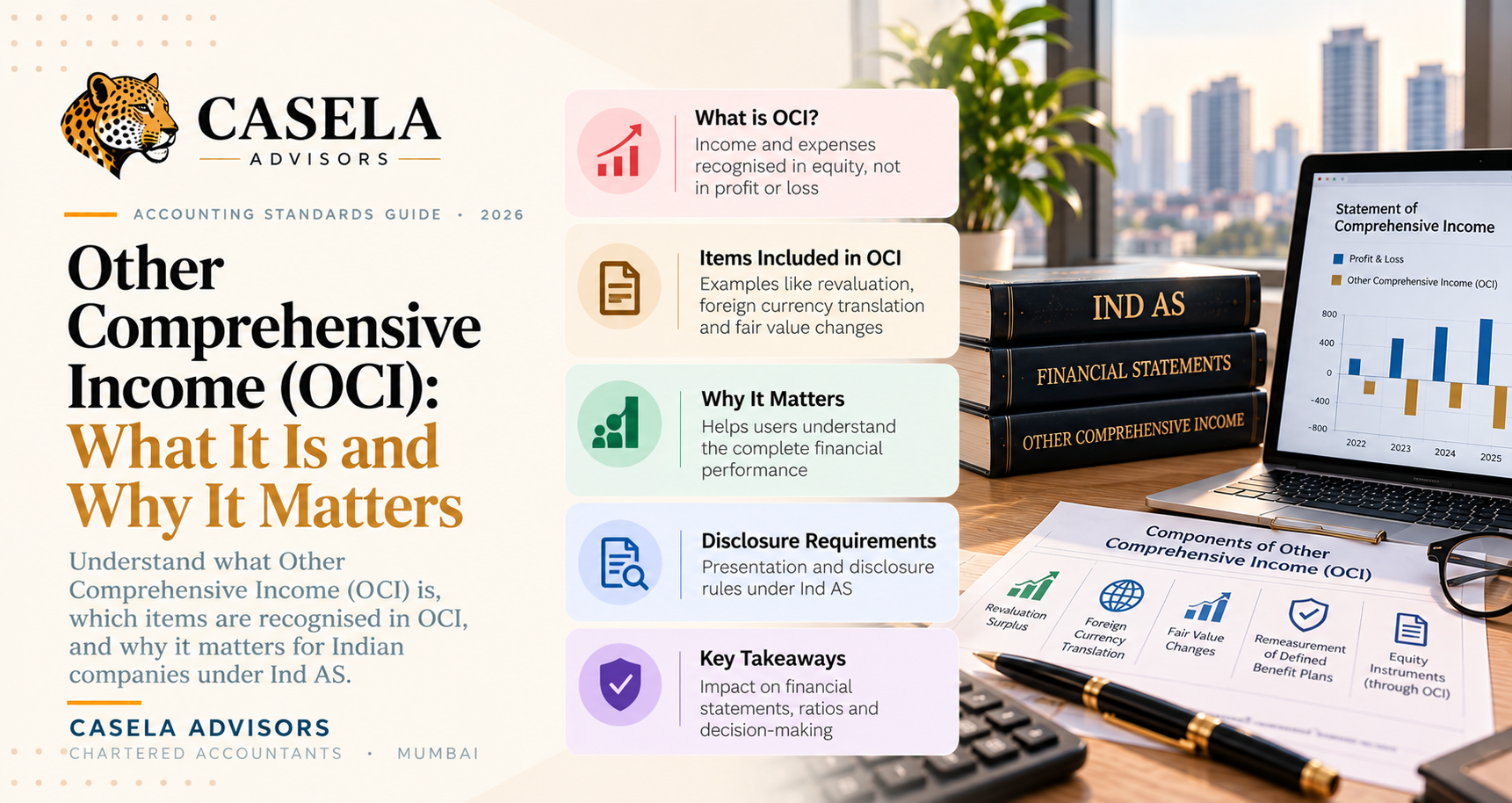
Most finance professionals understand the profit and loss statement — revenue in, expenses out, tax applied, profit declared. But Other Comprehensive Income (OCI) sits below that profit line in Indian financial statements, and its treatment under Ind AS is frequently misunderstood, inconsistently applied, and under-disclosed. For companies that hold financial instruments at fair value, have defined benefit obligations, operate in foreign jurisdictions, or use hedge accounting, OCI is not a footnote — it is a material part of the financial picture.
This guide explains what OCI is under Ind AS, which standards generate OCI items, the critical distinction between recyclable and non-recyclable OCI, the deferred tax requirements for OCI items, and how OCI is correctly presented in Schedule III Division II financial statements.
What this guide covers — at a glance
- OCI comprises items specifically directed out of profit or loss by individual Ind AS standards — it is not a catch-all for unusual items.
- Items must be split into those that will be reclassified to P&L and those that will never be reclassified — the distinction changes how equity reserves are managed.
- Deferred tax on OCI items is presented as a separate line in OCI, not mixed with deferred tax on profit or loss items.
- Accumulated OCI in equity is tracked in separate named reserves under Schedule III — not combined into retained earnings.
- Reclassification adjustments prevent double-counting when OCI items eventually flow through the P&L.
01What Is Other Comprehensive Income?
Under Ind AS 1 (Presentation of Financial Statements), total comprehensive income for a period comprises two components: profit or loss and other comprehensive income. OCI includes items of income and expense that are not recognised in profit or loss as required or permitted by other Indian Accounting Standards.
The key insight is that OCI is not a discretionary category. Finance professionals cannot choose to route items through OCI to avoid P&L volatility — each item goes where the relevant Ind AS standard mandates it. If Ind AS 19 says remeasurements of defined benefit plans go to OCI, they go to OCI. If Ind AS 109 says fair value changes on an FVOCI debt instrument go to OCI, they go to OCI. The mapping is prescribed, not elective.
The rationale for OCI is conceptual: certain gains and losses are real economic events, but their inclusion in profit or loss would create P&L volatility that misrepresents operating performance. Actuarial changes to a pension obligation, for instance, reflect long-run assumptions — reporting them immediately in P&L would distort single-period earnings. OCI provides a transparent home for these items without suppressing them in the notes.
02Which Ind AS Standards Generate OCI Items?
Six Indian Accounting Standards specifically mandate OCI treatment for particular items. Understanding which standard generates each OCI item is the starting point for correct classification, reclassification, and deferred tax treatment.
Ind AS 19 — Employee Benefits
Remeasurements of defined benefit obligations are recognised directly in OCI. These remeasurements include:
- Actuarial gains and losses arising from changes in demographic assumptions (e.g., mortality rates) and financial assumptions (e.g., discount rates)
- The return on plan assets, excluding amounts included in the net interest expense on the net defined benefit liability
- Changes in the asset ceiling effect (where applicable)
Ind AS 19 remeasurements are permanent OCI items — they will never be reclassified to profit or loss. They accumulate in the remeasurement reserve within Other Equity and may be transferred within equity (to retained earnings) but cannot return to the P&L.
Ind AS 109 — Financial Instruments
Ind AS 109 generates OCI from two distinct sources, with different reclassification treatment:
- FVOCI debt instruments: Fair value changes on debt instruments classified at Fair Value Through Other Comprehensive Income flow through OCI during the holding period. When the instrument is derecognised, the cumulative OCI gain or loss is reclassified (recycled) to profit or loss. Impairment losses and foreign exchange gains/losses on FVOCI debt instruments are still recognised in P&L. These items will be reclassified to P&L.
- FVOCI equity instruments (irrevocable election): An entity may irrevocably elect to classify equity instrument investments at FVOCI. Fair value changes go to OCI but are never reclassified to profit or loss — not even on disposal. Dividends are recognised in P&L. This election is item-by-item and irrevocable.
- Cash flow hedges: The effective portion of fair value changes on the designated hedging instrument is recognised in OCI. When the hedged item affects profit or loss (or is a non-financial asset/liability acquisition), the amount in OCI is reclassified to profit or loss. These items will be reclassified to P&L.
- Fair value hedges on own credit risk: Gains or losses on a financial liability designated at FVTPL attributable to the entity’s own credit risk are recognised in OCI and never reclassified.
Ind AS 21 — Effects of Changes in Foreign Exchange Rates
Exchange differences arising on translating the financial statements of a foreign operation into the presentation currency are recognised in OCI as part of the foreign currency translation reserve (FCTR). These exchange differences are reclassified to profit or loss when the foreign operation is disposed of (in full or in part). These items will be reclassified to P&L.
Ind AS 16 — Property, Plant and Equipment
Where the revaluation model is applied to PPE, increases in the carrying amount above historical cost are recognised in OCI as revaluation surplus. Revaluation decreases are first charged against any existing surplus in OCI and then taken to P&L. Revaluation surplus is permanently in equity — it may be transferred directly to retained earnings as the asset is used or derecognised, but is never reclassified through profit or loss.
Ind AS 38 — Intangible Assets
The same revaluation model treatment as Ind AS 16 applies where intangible assets are carried at revalued amounts (rare in practice, as this requires an active market for the asset). Revaluation gains go to OCI and will never be reclassified to P&L.
Ind AS 28 — Investments in Associates and Joint Ventures
When associates or joint ventures themselves have OCI items (from their own application of Ind AS 19, 109, 21, etc.), the investor recognises its share of those OCI items in its own OCI under the equity method. The reclassification treatment follows the original nature of the item at the investee level.
03The Critical Distinction: Recyclable vs Non-Recyclable OCI
Ind AS 1 requires OCI items to be grouped into two clearly labelled sub-sections based on whether they will subsequently be reclassified to profit or loss. This is the most important structural requirement for OCI presentation, and getting it wrong is one of the most common Schedule III compliance errors.
| OCI Item | Ind AS Source | Reclassification to P&L? | Trigger for Reclassification |
|---|---|---|---|
| Remeasurements of defined benefit plans | Ind AS 19 | Never | Permanently in OCI / may transfer within equity |
| FVOCI equity instruments (irrevocable election) | Ind AS 109 | Never | Permanently in OCI; dividends in P&L separately |
| PPE / Intangible revaluation surplus | Ind AS 16/38 | Never | May transfer within equity on use / derecognition |
| Own credit risk (FVTPL liability) | Ind AS 109 | Never | Permanently in OCI |
| Effective portion of cash flow hedges | Ind AS 109 | Yes | When hedged item affects P&L or is a non-financial asset acquisition |
| FVOCI debt instruments | Ind AS 109 | Yes | On derecognition of the debt instrument |
| Foreign currency translation differences — foreign operations | Ind AS 21 | Yes | On disposal / partial disposal of the foreign operation |
| Share of OCI of associates / JVs | Ind AS 28 | Follows underlying nature | Mirrors the reclassification treatment at the investee |
Presenting “will be reclassified” and “will not be reclassified” items in a single undifferentiated OCI block is a Schedule III Division II non-compliance. Financial statement users need this split because recyclable OCI has future P&L implications — it signals that the income statement will be affected when hedges mature, foreign operations are divested, or debt instruments are sold. Non-recyclable OCI, by contrast, is permanently absorbed into equity.
04Reclassification Adjustments — Avoiding Double-Counting
When an OCI item that will be reclassified eventually flows into profit or loss, there is a mechanical risk of double-counting unless the reclassification adjustment is correctly handled. Ind AS 1 requires disclosure of reclassification adjustments — the amounts that are moved from OCI to profit or loss in the current period.
Consider a cash flow hedge: when a company hedges an anticipated export sale, the gain on the hedging instrument accumulates in the cash flow hedge reserve in OCI as the derivative fair value changes. When the hedged sale actually occurs and is recognised as revenue, the accumulated OCI balance is reclassified to the P&L. The reclassification adjustment is the amount transferred — it reduces the OCI balance to zero and increases profit or loss.
Ind AS 1 permits entities to present reclassification adjustments either in the OCI section of the Statement of Profit and Loss, or in the notes (with gross amounts in the statement). Either approach is acceptable, but the choice must be applied consistently and the reclassification amounts must be visible — they cannot be netted away silently.
05Deferred Tax on OCI Items
Ind AS 12 (Income Taxes) requires income tax relating to each component of OCI to be disclosed. This is one of the most technically demanding aspects of OCI accounting because the deferred tax arising on OCI items must be tracked separately from the deferred tax arising on profit or loss items — they move through different parts of the financial statements.
Two approaches for presenting income tax on OCI
Ind AS 1 permits two presentation formats for tax on OCI:
- Gross presentation: Each OCI component is shown at the gross amount (before tax), with a single aggregate “income tax relating to OCI items” line at the bottom of the OCI section, and then the net OCI after tax.
- Net presentation: Each OCI component is shown net of its individual tax effect. The individual tax amounts must then be disclosed in the notes.
Indian companies most commonly adopt the gross presentation approach because it is more transparent and satisfies the Schedule III format more cleanly.
Deferred tax recognition on non-recyclable OCI items
A deferred tax liability or asset arising on an OCI item is recognised in OCI — not in profit or loss. For remeasurements of defined benefit plans, for example, if an actuarial gain increases the plan asset or reduces the obligation, the deferred tax liability on that gain is recognised in OCI in the same period. When the entity subsequently contributes to the plan or the obligation crystallises, the deferred tax balance in OCI unwinds through OCI — it does not pass through the P&L.
A frequent error in Ind AS financial statements is routing the deferred tax effect of OCI items through the P&L deferred tax line rather than through OCI. This overstates deferred tax credit/charge in profit or loss and understates OCI net of tax — distorting both total comprehensive income attribution and the deferred tax note reconciliation. Auditors should specifically verify the movement in the deferred tax liability/asset is correctly split between the P&L charge and the OCI charge.
06OCI in the Balance Sheet — Reserves Under Other Equity
Every OCI item that is recognised accumulates in a named reserve within Other Equity in the balance sheet under Schedule III Division II. These reserves are separate line items — they cannot be merged into the general surplus (retained earnings) or any other reserve without specific accounting justification.
Reserves arising from OCI under Schedule III
- Securities Premium — not OCI-related; already a Schedule III requirement
- Capital Redemption Reserve — not OCI-related
- Retained Earnings / Surplus — profit-related; OCI does not flow here directly
- Other Comprehensive Income Reserve — encompasses:
- Remeasurement of Defined Benefit Plans (net of tax)
- FVOCI Equity Instruments Reserve (net of tax)
- Cash Flow Hedging Reserve (net of tax)
- Foreign Currency Translation Reserve (FCTR)
- Revaluation Surplus (for PPE/intangibles under revaluation model)
Ind AS 19 remeasurement losses accumulated in the DB remeasurement reserve, and revaluation surplus from Ind AS 16, may be transferred within equity (to retained earnings) — but this is an equity-to-equity transfer, not a reclassification through profit or loss. The transfer is shown in the Statement of Changes in Equity (SOCE) and must be distinguished from the reclassification adjustments that flow through OCI in the P&L. Many Ind AS first-time adopters confuse the two.
07Schedule III Division II — Presentation Requirements for OCI
For Indian companies preparing Ind AS financial statements, the presentation format for OCI is governed by Schedule III Division II of the Companies Act 2013, which prescribes the format of the Statement of Profit and Loss.
The required structure is:
- Profit / (Loss) for the period (after tax)
- Other Comprehensive Income:
- (A) Items that will not be reclassified to profit or loss — with line items and tax effects
- (B) Items that will be reclassified to profit or loss — with line items and tax effects
- Total Other Comprehensive Income for the period (net of tax)
- Total Comprehensive Income for the period (1 + 3)
- Attribution of Total Comprehensive Income to:
- Owners of the parent
- Non-controlling interests
In consolidated financial statements, both the profit for the period and the total comprehensive income must be separately attributed to owners of the parent and non-controlling interests. This is a hard requirement — a single blended line is not sufficient.
08OCI in the Statement of Changes in Equity
The Statement of Changes in Equity (SOCE) provides the link between the OCI in the P&L and the OCI reserves in the balance sheet. The SOCE must show each OCI component as a separate column (or with movements explained in sufficient detail), tracking the opening balance, additions during the period, reclassifications to P&L, transfers within equity, and closing balance for each OCI reserve.
For groups with material OCI items, the SOCE becomes one of the more complex statements to prepare — particularly when foreign subsidiaries have their own OCI items that feed into the group’s FCTR, or when associates’ OCI shares must be incorporated under the equity method.
In a consolidated group, FCTR movements must be tracked entity-by-entity because partial disposals of foreign subsidiaries trigger partial FCTR reclassification. Systems that consolidate OCI at a group level without entity-level FCTR tracking cannot correctly calculate the reclassification adjustment on partial disposals — one of the most frequent consolidation ICFR gaps identified in groups with multiple overseas subsidiaries.
09Common OCI Compliance Errors in Practice
Based on audit and accounting advisory experience across Ind AS corporate groups, these are the most frequently encountered OCI compliance errors:
- 1Presenting all OCI items in a single undifferentiated block rather than splitting them into the “will be reclassified” and “will not be reclassified” sub-sections mandated by Schedule III and Ind AS 1.
- 2Routing the deferred tax effect of OCI items (especially Ind AS 19 remeasurements and FVOCI instrument fair value changes) through the profit or loss deferred tax charge rather than through OCI — distorting both the P&L tax line and the OCI net-of-tax disclosure.
- 3Omitting reclassification adjustments when cash flow hedges mature or FVOCI debt instruments are sold — causing double-counting of gains or losses.
- 4Treating an irrevocable FVOCI equity election as subject to reclassification on disposal — a fundamental misclassification that inflates P&L on exit.
- 5Disclosing OCI from associates and joint ventures without correctly splitting it between recyclable and non-recyclable categories in line with the nature of the underlying item at the investee.
- 6Failing to present Total Comprehensive Income separately attributable to owners of the parent and non-controlling interests in consolidated financial statements.
- 7Transferring defined benefit plan remeasurements from the OCI reserve to retained earnings via the Statement of Changes in Equity — but incorrectly routing the transfer through the P&L as a reclassification adjustment.
10OCI Under Ind AS — Summary Reference Table
| Standard | OCI Item | Recyclable? | Reserve in Equity |
|---|---|---|---|
| Ind AS 19 | Remeasurements of defined benefit plans (actuarial G/L, return on plan assets excl. interest) | Never | Remeasurement Reserve |
| Ind AS 109 | Fair value changes — FVOCI debt instruments | Yes — on derecognition | FVOCI Debt Reserve |
| Ind AS 109 | Fair value changes — FVOCI equity instruments (irrevocable) | Never | FVOCI Equity Reserve |
| Ind AS 109 | Effective portion of cash flow hedge gains / losses | Yes — when hedge item affects P&L | Cash Flow Hedge Reserve |
| Ind AS 109 | Own credit risk (FVTPL financial liability) | Never | Own Credit Risk Reserve |
| Ind AS 21 | Exchange differences on translating foreign operations | Yes — on disposal | Foreign Currency Translation Reserve (FCTR) |
| Ind AS 16 | Revaluation surplus on PPE | Never (transfer within equity) | Revaluation Surplus |
| Ind AS 38 | Revaluation surplus on intangible assets | Never (transfer within equity) | Revaluation Surplus |
| Ind AS 28 | Share of OCI of associates / joint ventures | Follows underlying nature | Mirrors relevant reserve at investee level |
How Casela Advisors can help
We provide technical accounting support for OCI treatment, deferred tax reconciliation, and Schedule III-compliant financial statement preparation for Ind AS companies.
Ind AS implementation — OCI classification, reserves set-up, and SOCE preparation
Deferred tax diagnostic — split of OCI vs P&L deferred tax and note reconciliation
ICFR review of OCI accounting controls — Ind AS 19, 109, 21 processes
Statutory audit of Schedule III Div. II financial statements
11Frequently Asked Questions
What is Other Comprehensive Income (OCI) under Ind AS?
OCI under Ind AS comprises items of income and expense that are not recognised in profit or loss as required or permitted by other Ind AS standards. Governed by Ind AS 1, OCI is presented below the profit-after-tax line in the Statement of Profit and Loss, and includes remeasurements of defined benefit plans, fair value changes on FVOCI financial instruments, effective portions of cash flow hedges, foreign currency translation differences on foreign operations, and revaluation gains on PPE and intangibles. OCI is not discretionary — each item goes to OCI because the relevant standard mandates it.
What is the difference between recyclable and non-recyclable OCI?
Recyclable (reclassifiable) OCI items will eventually be transferred to profit or loss when specific conditions are met — such as when a hedge matures, a foreign operation is disposed of, or an FVOCI debt instrument is sold. Non-recyclable OCI items are permanently in equity and will never pass through profit or loss — they include Ind AS 19 remeasurements, FVOCI equity instrument gains/losses under the irrevocable election, and PPE/intangible revaluation surplus. Ind AS 1 and Schedule III require these two categories to be presented in separate sub-sections of the OCI statement.
How is deferred tax presented on OCI items under Ind AS?
Under Ind AS 12, tax on OCI items must be recognised in OCI — not in the P&L deferred tax charge. Companies may show OCI items gross with an aggregate tax line, or net of individual tax effects (with disclosure in the notes). The deferred tax balance arising on OCI items accumulates in the relevant OCI reserve within Other Equity on the balance sheet. Routing OCI deferred tax through the P&L is a common error that distorts both the income tax charge and the OCI disclosure.
Can Ind AS 19 remeasurements be transferred to retained earnings?
Yes — Ind AS 19 permits (but does not require) entities to transfer the accumulated remeasurement reserve within equity to retained earnings. However, this transfer is an equity-to-equity movement shown in the Statement of Changes in Equity (SOCE) — it does not pass through profit or loss. It must be distinguished from a reclassification adjustment, which would be shown in OCI in the Statement of Profit and Loss. DB remeasurements are categorically non-reclassifiable and can never pass through the P&L.
Which Indian Accounting Standards generate OCI items?
The primary standards are: Ind AS 19 (defined benefit plan remeasurements); Ind AS 109 (fair value changes on FVOCI debt and equity instruments, effective cash flow hedge portion, own credit risk on FVTPL liabilities); Ind AS 21 (exchange differences on foreign operations); Ind AS 16 (PPE revaluation surplus); Ind AS 38 (intangible revaluation surplus); and Ind AS 28 (share of OCI of associates and joint ventures under the equity method).
How is OCI presented in Schedule III Division II financial statements?
Schedule III Division II requires the Statement of Profit and Loss to present, below the profit for the period: (A) Items that will not be reclassified to profit or loss — with line items and tax effects; and (B) Items that will be reclassified to profit or loss — with line items and tax effects. Total comprehensive income follows, attributed separately to owners of the parent and non-controlling interests in consolidated statements. Presenting all OCI in a single block without the A/B split is a Schedule III non-compliance.
12The Bottom Line
Other Comprehensive Income is not an accounting afterthought — it is a materially significant portion of total comprehensive income for any Indian company with defined benefit pension plans, financial instruments at fair value, foreign subsidiaries, or hedging programmes. Getting OCI right requires understanding which standard creates each item, whether that item will recycle to P&L and when, how deferred tax flows through OCI separately from P&L deferred tax, and how all of it maps to the Schedule III Division II format and the Statement of Changes in Equity. These are interconnected requirements, and errors in one cascade through the others. The time to build the controls and accounting framework for OCI is during Ind AS implementation — not at year-end when the auditors arrive.
Need support with OCI accounting under Ind AS?
Whether it is getting OCI classification right for the first time, reconciling deferred tax on OCI items, or reviewing your Schedule III presentation — our Ind AS team can help you get it right.