
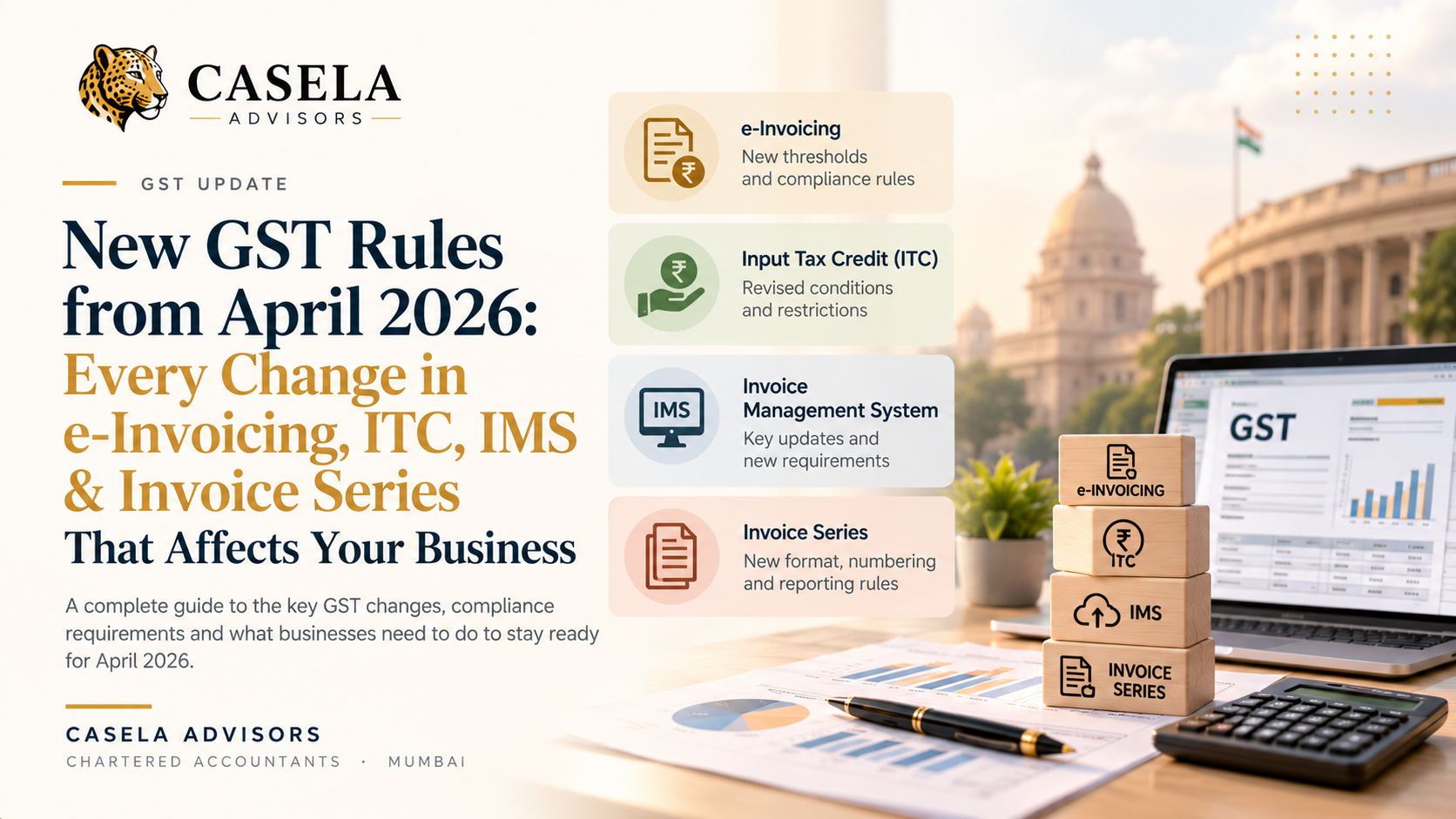
Every April, GST compliance resets. This year the reset comes with sharper edges: e-invoicing thresholds that now bite lower, a 30-day reporting limit, an Invoice Management System that shapes your credit, and a credit reversal statement that is being watched. Here is what changed and what to do.
Casela Advisors is a Chartered Accountant firm in Andheri East, Mumbai, filing GST returns for clients across sectors. Thresholds and deadlines below are as summarised from public GST updates and notifications; confirm the exact notification for your case before acting.
What this guide covers — at a glance
- New financial year, new invoice series. Every invoice, debit note and credit note starts a fresh sequence from 1 April 2026.
- E-invoicing applies above ₹5 crore. Businesses whose aggregate turnover crossed ₹5 crore must issue e-invoices, and larger taxpayers face a 30-day reporting window.
- IMS decides what ITC you see. Accepting, rejecting or holding supplier invoices and credit notes in the Invoice Management System shapes your GSTR-2B and your claim.
- Exporters must file a fresh LUT. Last year's Letter of Undertaking lapses on 31 March, and a new one is needed before issuing export invoices without paying IGST.
- Credit reversal data is being watched. Negative balances in the electronic credit reversal statement already raise warnings and may later block returns.
- Several smaller rules changed too. Export refund minimum removed, Rule 14A withdrawal eased, and GTA declarations to be checked.
01The Changes at a Glance
| Change | Who it affects | What to do |
|---|---|---|
| Fresh invoice series | All registered taxpayers | Start new numbering for invoices, debit notes and credit notes from 1 April 2026 |
| E-invoicing | Aggregate turnover above ₹5 crore in any year since 2017-18 | Generate IRN through the IRP for B2B invoices, debit and credit notes |
| 30-day IRP reporting | Turnover of ₹10 crore and above | Report e-invoices within 30 days of the invoice date or risk invalid invoices and lost ITC |
| Invoice Management System | Anyone claiming ITC | Accept, reject or hold supplier invoices and credit notes before filing GSTR-3B |
| Electronic credit reversal statement | Anyone with ITC reversals | Clear negative balances and keep data accurate |
| LUT for FY 2026-27 | Exporters and SEZ suppliers | File a fresh Form RFD-11 before issuing the first export invoice |
| Export refund floor removed | Exporters claiming refunds | Small refund claims below ₹1,000 are no longer excluded |
| GTA declaration | Recipients of goods transport services | Collect forward charge or reverse charge declaration from each GTA |
02A Fresh Invoice Series
GST requires invoice numbers to be consecutive, unique for the financial year and within the permitted length. Each April therefore starts a new series for tax invoices, debit notes and credit notes. Carrying the old sequence forward makes reconciliation harder and can attract questions in an audit.
Add a year marker or prefix so that numbers stay unique across years, and test the series in your billing software before the first live invoice.
03E-Invoicing and the 30-Day Rule
E-invoicing applies to registered taxpayers whose aggregate annual turnover exceeded ₹5 crore in any financial year since 2017-18. Eligible B2B invoices, exports, and related debit and credit notes must be reported to the Invoice Registration Portal to obtain an Invoice Reference Number.
Taxpayers with aggregate turnover of ₹10 crore and above must also report within 30 days of the invoice date. An invoice reported after that may be treated as invalid, which can put the recipient's ITC at risk and create friction with customers.
If your e-invoice is rejected for late reporting, your customer may not get ITC on it. Build a daily check for invoices without an IRN, and do not leave bulk uploads until month-end.
04ITC, IMS and the Credit Reversal Statement
The Invoice Management System lets you accept, reject or hold the invoices and credit notes that your suppliers report. Those choices feed into your GSTR-2B and so into the credit you can claim. Pending items need action before you file GSTR-3B.
If a customer rejects a credit note you issued, it affects their credit and your books, so follow up promptly. Separately, the electronic credit reversal statement is tracking reversals; negative closing balances already raise warnings and may later restrict return filing. Reconcile reversals in books against returns before they become a problem.
Review IMS, reconcile with GSTR-2B, clear differences with suppliers, then file GSTR-3B. Doing it in that order avoids most credit disputes.
05Other Changes That May Apply to You
- LUT for exporters. A Letter of Undertaking is valid for one financial year. File Form RFD-11 for FY 2026-27 before issuing export invoices without paying IGST.
- Export refunds. The minimum amount below which refund applications were not processed has been removed.
- Goods transport agencies. Collect a written declaration of forward charge or reverse charge so liability is on the right party.
- Voluntary withdrawal under Rule 14A. The condition for withdrawing has been eased to one complete tax period.
- Composition and cash-ledger rules. Composition opt-in windows close before the year starts, and Rule 86B can require part of tax to be paid in cash for large taxpayers.
06An Eight-Step Action Plan
- 1Open a new document series. Configure your billing software for a fresh numbering sequence that is unique for the financial year and within the length limit, and test it before the first invoice.
- 2Check your e-invoicing status. Confirm whether your aggregate turnover crossed ₹5 crore in any year since 2017-18, and whether the 30-day window applies to you.
- 3Monitor IRP reporting. Set up an alert for any invoice approaching 30 days without an IRN.
- 4Review IMS every month. Before filing GSTR-3B, act on pending invoices and credit notes and reconcile with GSTR-2B.
- 5Tell customers about rejections. If a customer rejects your credit note in IMS, find out why and fix it, because it affects their ITC and your records.
- 6File the LUT. Exporters should file Form RFD-11 for FY 2026-27 before issuing export invoices.
- 7Clean up the credit reversal statement. Match reversals in books and returns, and clear negative closing balances.
- 8Check GTA declarations and ISD. Make sure each transporter has declared forward or reverse charge, and that distribution of common credit is set up where required.
07Six Common Mistakes
Carrying last year's numbering forward.
Continuing the old series breaks the reset, creates reconciliation problems and invites questions in a GST audit.
Reporting e-invoices late.
For taxpayers within the 30-day rule, an invoice reported late may be treated as invalid, and the recipient can lose ITC. Build a daily check.
Ignoring IMS and relying on GSTR-2B alone.
Invoices left pending or rejected change what flows into your credit. Review IMS before you file.
Forgetting the LUT.
Without a valid LUT for the year, export invoices may have to be issued with IGST, tying up cash until refund.
Leaving credit reversals uncorrected.
Negative balances in the reversal statement can trigger warnings today and restrictions later.
Assuming small changes do not matter.
Even a withdrawn threshold or a declaration requirement can change a liability, so read the notifications that affect your business.
GST support from us
We manage GST end to end, from billing set-up to monthly returns and notices. These are the services most often involved:
Monthly GST return filing with IMS review and GSTR-2B reconciliation is the core of what we do.
Billing set-up, series reset and clean ledgers sit with outsourced bookkeeping.
Reconciliation, controls and reporting are part of our virtual CFO and accounting tax compliance practice.
Deductions and returns that sit alongside GST: TDS return filing.
Not sure which of these changes apply to you? Start through the contact page.
08Frequently Asked Questions
Do I really have to start a new invoice series on 1 April?
Yes. Invoice numbers must be consecutive and unique for a financial year, so each new year starts a new series. Use a prefix or year marker so that numbers stay unique.
Who has to issue e-invoices?
Registered taxpayers whose aggregate turnover exceeded ₹5 crore in any financial year from 2017-18 onwards, for B2B supplies and exports and related debit and credit notes. Check the exemptions that apply to your category.
What is the 30-day rule for e-invoices?
Taxpayers with aggregate turnover of ₹10 crore and above must report e-invoices to the IRP within 30 days of the invoice date. Invoices reported later may be rejected, which can affect the recipient's ITC.
What is IMS and do I need to use it?
The Invoice Management System lets you accept, reject or keep pending the invoices and credit notes your suppliers report. Your GSTR-2B and ITC reflect those actions, so any taxpayer claiming credit should review it each month.
Do exporters need a new LUT every year?
Yes. An LUT is valid for a single financial year, so exporters file Form RFD-11 for FY 2026-27 before issuing export invoices without paying IGST.
09The Bottom Line
The April 2026 changes are less about new taxes and more about discipline: a clean series, timely e-invoices, a monthly IMS review and clear LUTs and declarations. Put those in a calendar now and the year runs smoothly.
Want a GST Health Check?
GST Return Filing • E-Invoicing Support • IMS & ITC Reconciliation • LUT Filing • Notices & Audits
+91 9819 000 227 · +91 9819 000 511 · +91 9765 000 966 · info@caselaadvisors.com Head Office — Suit No. 102, L1, Ashok Premises, Nicholas Road, Andheri East, Mumbai — 400069 · Monday to Saturday, 10:00 AM – 7:00 PM