
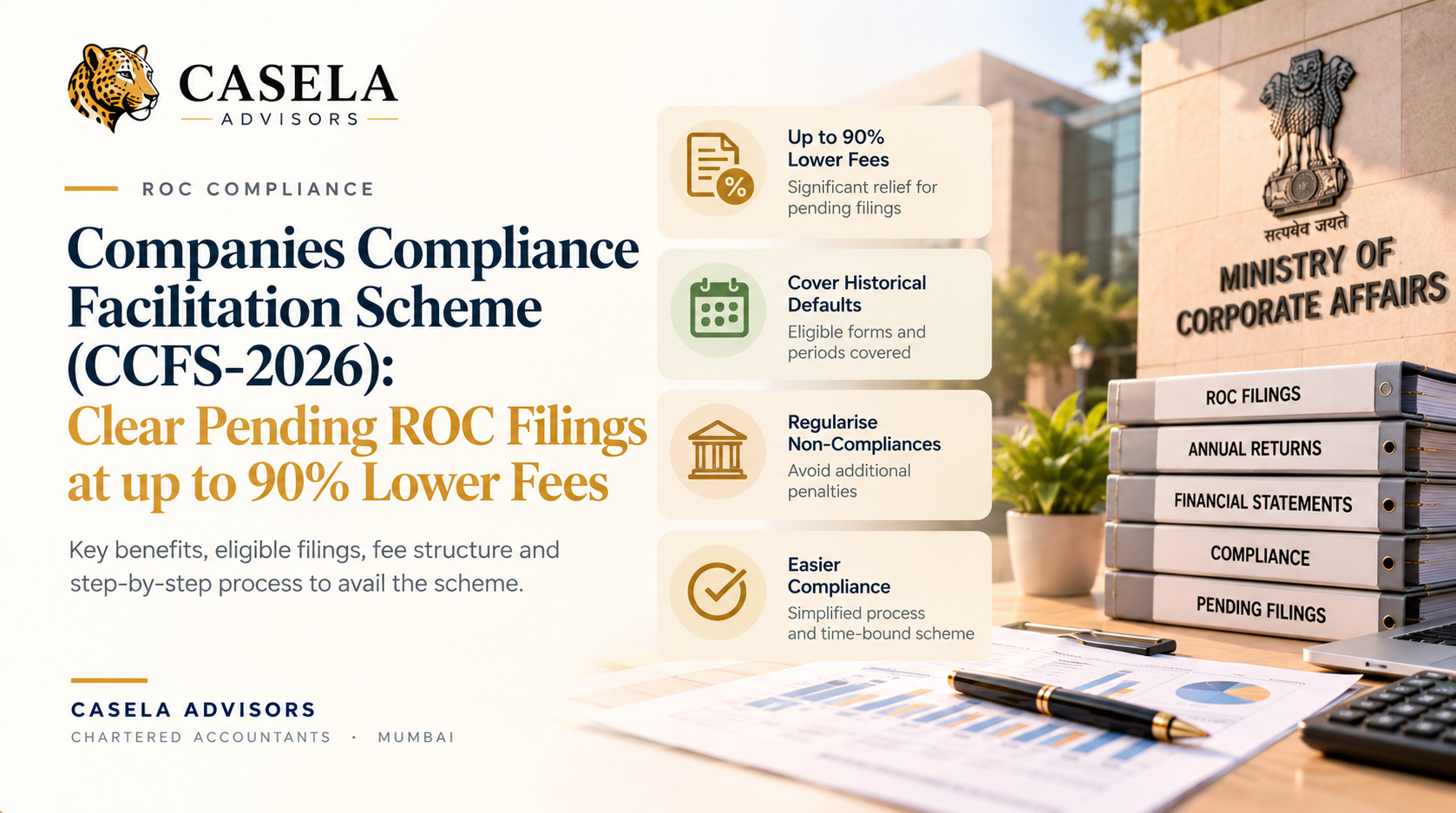
Every few years the Ministry of Corporate Affairs gives defaulting companies a chance to clear old ROC filings without paying the full weight of late fees. The Companies Compliance Facilitation Scheme, 2026 was the latest, and its 90% reduction on additional fees made it one of the most valuable windows in recent years.
Casela Advisors is a Chartered Accountant firm in Andheri East, Mumbai. This guide sets out how the scheme worked, who could use it, what it cost, and what a company that missed it should do next. The dates and fee rules are summarised from public updates on MCA General Circular No. 01/2026 and its extensions, and should be confirmed against the circulars themselves.
What this guide covers — at a glance
- CCFS-2026 cut the late fees, not the filing duty. Eligible companies paid the normal filing fee plus only 10% of the accumulated additional fees — a 90% reduction on the late-filing charge.
- It covered annual filings. The core forms were MGT-7 and MGT-7A (annual return), the AOC-4 series (financial statements), ADT-1, and the foreign company forms FC-3 and FC-4.
- Three pathways. Catch up on pending filings, apply for dormant status, or apply to strike the company off.
- The window has moved more than once. It was announced for 15 April to 15 July 2026 and was extended; public updates put the final close at 15 September 2026. Confirm against the MCA circulars.
- If you missed it, the old regime is back. Additional fees of ₹100 a day with no upper limit, penalties and director consequences resume.
- A catch-up plan still helps. Filing the oldest years first, and settling the company's position, limits further damage.
01What CCFS-2026 Was
The scheme was announced by the MCA through General Circular No. 01/2026 dated 24 February 2026. It applied to companies with pending statutory filings and gave them a time-limited window to regularise their position at a reduced cost. No separate application was needed; companies filed the pending forms on the MCA21 portal during the window and the reduced additional fee was applied.
The scheme was announced for 15 April to 15 July 2026. Later circulars extended the window, and public updates put the final close at 15 September 2026. Sources differ on the intermediate dates, so confirm them in the MCA circulars before quoting them.
02The Three Pathways
| Pathway | Forms | Fee |
|---|---|---|
| 1 — Regularise | Pending annual returns and financial statements (MGT-7/7A, AOC-4 series, ADT-1, FC-3, FC-4) | Normal fee plus 10% of additional fees |
| 2 — Dormant status | Form MSC-1 | 50% of the normal fee |
| 3 — Strike-off | Form STK-2 | 25% of the normal fee |
03How the 90% Reduction Worked
For late filings, the Companies Act charges additional fees of ₹100 for each day of delay, with no upper limit. Under the scheme, a company paid the normal filing fee plus only 10% of the accumulated additional fees. A simple illustration:
| Line | Basis | Amount |
|---|---|---|
| Delay | 300 days at ₹100 a day | ₹30,000 of additional fees |
| Under CCFS-2026 | 10% of additional fees | ₹3,000 |
| Saving | Difference | ₹27,000 |
Because the additional fee applied form by form and year by year, companies with several overdue years often saw the largest savings.
04Immunity and Exclusions
Filing under the scheme was reported to give protection from adjudication-related penalties under Section 454 for the annual return and financial statement defaults it covered, with the condition that no adjudication order had already been passed. Where an adjudicating officer had already imposed a penalty, that order was not covered.
The scheme excluded companies already facing final strike-off action, those that had applied for strike-off or dormant status, amalgamated or dissolved companies, and vanishing companies.
Outside the window, additional fees run at ₹100 a day per form with no ceiling. Continued default can also lead to penalties on the company and its officers, disqualification of directors and, in the end, the Registrar striking the company off.
05If You Missed It: A Catch-Up Plan
- 1List every pending filing. Check the MCA record for each financial year: AOC-4, MGT-7 or 7A, ADT-1 and any other form that is overdue.
- 2Prepare the oldest year first. Financial statements, auditor's report, board and AGM records for each missed year need to exist before they can be filed.
- 3Hold the AGM and board approvals. Missing meetings and signatures are the most common reason catch-up takes longer than expected.
- 4Check director status. Directors of companies that miss filings for three consecutive years can face disqualification, which affects every company they serve on.
- 5Estimate the full cost. Add the normal fee, additional fees at ₹100 a day per form, professional fees and any penalty exposure to decide the best route.
- 6Consider the alternative. If the company has no future use, dormant status or strike-off may cost less than years of catch-up. Take advice on the effects.
- 7File and reconcile. File each form, keep the SRNs, and update the statutory registers so the company is current again.
06Six Common Mistakes
Assuming the window is still open.
Public updates indicate the scheme closed on 15 September 2026. Verify the latest MCA circular before relying on any fee quoted online.
Filing only the latest year.
The scheme applied to all pending filings. Partial catch-up leaves earlier years accumulating fees and exposure.
Ignoring an existing adjudication order.
Immunity did not extend to a penalty already imposed by an adjudicating officer before filing.
Treating dormant status as a pause button.
A dormant company still has obligations. It is a different compliance track, not an exemption.
Forgetting director consequences.
Persistent default can lead to disqualification of directors under the Companies Act, affecting their other directorships.
Waiting for the next scheme.
MCA has run amnesty windows before, but there is no guarantee of another. Delay compounds at ₹100 a day with no cap.
Getting your company current with us
We prepare overdue financial statements, hold the required meetings and file the pending forms. These are the services most often involved:
ROC filings, AGMs and board records are part of our virtual CFO and accounting tax compliance practice.
Year-by-year financial statements start from clean books; see outsourced bookkeeping.
Companies that also owe tax filings can add GST return filing and TDS return filing.
Understanding your company's numbers before you file: MIS and budgeting.
Unsure what is pending on your company? Start through the contact page.
07Frequently Asked Questions
What was the Companies Compliance Facilitation Scheme, 2026?
It was an MCA relief scheme, announced through General Circular No. 01/2026 dated 24 February 2026, that let defaulting companies file overdue annual returns and financial statements by paying the normal fee plus only 10% of the additional fees.
What was the deadline?
The scheme was announced for 15 April to 15 July 2026 and was extended by later circulars. Public updates put the close at 15 September 2026. Check the MCA circulars for the exact date and whether anything has changed since.
Is the scheme still available?
Based on public updates available when this was written, it has closed. Check the MCA website for any new window before assuming relief is available.
Which companies could not use it?
Companies already facing final strike-off action, those that had applied for strike-off or dormant status, amalgamated or dissolved companies, and vanishing companies.
What are the risks of continuing to default?
Additional fees of ₹100 per day with no upper limit, adjudication and penalties under the Companies Act, possible disqualification of directors, and the company being struck off by the Registrar.
08The Bottom Line
CCFS-2026 showed how costly delay is and how quickly relief can disappear. If your company was not able to use the window, the right move is still to count the pending filings, put a cost on staying put, and either bring the company current or decide deliberately to close it. Watch the MCA site for any new window, but do not plan around one.
Need Help Clearing Pending ROC Filings?
Overdue AOC-4 & MGT-7 • Dormant Status & Strike-Off • Director Compliance • ROC Filings • Virtual CFO Support
+91 9819 000 227 · +91 9819 000 511 · +91 9765 000 966 · info@caselaadvisors.com Head Office — Suit No. 102, L1, Ashok Premises, Nicholas Road, Andheri East, Mumbai — 400069 · Monday to Saturday, 10:00 AM – 7:00 PM